

1-Visitor
March 23, 2017
Solved

Displacement Problem

  • March 23, 2017
  • 2 replies
  • 3795 views

Hello User Community,

So I have another issue similar to yesterday where I am trying to follow the logic to the solution to a problem I have.

Again I am sure this is my poor Algebra skills but looking for clarity.

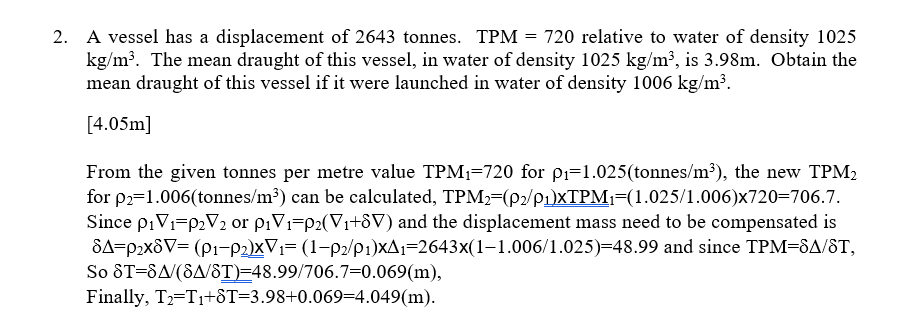
Below is the problem is the question and the model answer:
Displacement.PNG

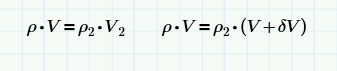
The part I am struggling to follow is the displacement mass difference derivation. I follow that:
pvs.PNG

i.e. the product of the initial density and under water volume must equal the second density and underwater volume. Therefore, the first density and underwater volume is equal to the second density multiplied by the initial volume plus the difference in volumes i.e. the second volume.

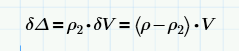
I can also follow that:
Capture.PNG

The difference in displacement mass (between floating in salt water to floating in near fresh water) is equal to the second density multiplied by the difference in volumes which logically is going to give a difference in masses. This being equal to the difference in densities multiplied by the initial volume.

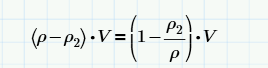
I can also follow that:
Capture1.PNG

by way of dividing rho2 by rho and rho by itself.

What I then struggle to follow is:
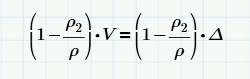
Capture2.PNG

The only way I can think of doing this is by substituting volume for displacement mass but surely this would give:
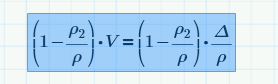
Capture3.PNG?

Can anyone shed some light on this?

Andy.

Best answer by MJG

Your algebra is correct.  You can show this with Mathcad:

Also, be careful using Delta as a variable.  Delta is a built-in function.  I had to manually change the label from "function" to "variable".

In your screenshot, the first Delta is non-italicized, but the next three are italicized, so I think they have different labels applied.

2 replies

23-Emerald I
March 23, 2017

The change in displace volume of water due to density change:

The "area" of the ship at the waterline:

The new draught (new volume divided by area:

awibroe1-VisitorAuthor
1-Visitor
March 23, 2017

Hi Fred,

That certainly seems like another way of doing it.

One thing I am intrigued by is that you have suggested waterplane area can be derived by underwater volume/ draft. Would this not give a mean area over the draft i.e. over the entire volume that is under water? i.e. the waterplane area would change dramatically as the vessel floats higher in the water assuming it is not a wall sided ship.

I am hoping that someone can follow the model answer that I have been given and explain how the step I set out above is derived as I am struggling to understand how this has been done.

Cheers,

Andy.

23-Emerald I
March 23, 2017

You are correct, my solution assumes a constant area.  The difference in draught is 0.07 meters, about three inches.  How much do you think the area might change?

awibroe1-VisitorAuthor
1-Visitor
March 23, 2017

I have given this allot of thought regarding the point I am stuck on and am not sure if the algebra is correct so would appreciate a second opinion. Is it correct to act as follows:

Capture5.PNG

Replacing V for Delta/Rho as volume = mass/ density, this can be rearranged to rho-rho2/rho *Delta. This is where I am not sure but I believe that as rho-rho2 is over a common denominator it can be said to be "2 fractions" therefore rho/rho - rho2/rho which is obviously 1 - rho2/rho. Is anyone able to confirm if this is mathematically sound or the ramblings of a sleep deprived student?

MJG1-VisitorAnswer
1-Visitor
March 23, 2017

Your algebra is correct.  You can show this with Mathcad:

Also, be careful using Delta as a variable.  Delta is a built-in function.  I had to manually change the label from "function" to "variable".

In your screenshot, the first Delta is non-italicized, but the next three are italicized, so I think they have different labels applied.

awibroe1-VisitorAuthor
1-Visitor
March 24, 2017

Thanks for that, Had no idea. Everyday is a school day!