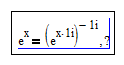
Exponentiation in the complex domain is not so easy and straightforward as in the real domain.
Mathcad, as already often stated, is not really good in that cases. Simply because Mathcad tells us that a specific equation has just one solution sure is no proof that thats true and simply because Mathcad tells us that two indefinite integrals are equal does not proof that one of the integrands might not be a multivalued expression.
For problems like yours its better to use mathematics and not Mathcad.
But even though Mathcad has its limits here, there seems to be a reason why Mathcad does (correctly) NOT simplify to 1 here:
Or please notice the difference here:
The reason seems to be that if x is a complex number, then (e^x)^j is multivalued, while e^(x*j) is not.
So it looks like MuPad's developers were aware of the difference concerning exponentiation in R and in C and so are quite careful in some simplifications. This is often annoying when we implicitly assume the real domain but MuPad insists that if not told otherwise the domain is set of complex numbers (this was easier at the times of Maple).
And while they were aware of the problems with exponentiation, they had not fully implemented the correct math (or Mathcad is not using the full potential of Mupad, not sure).
The truth is that for real values of x
So its a multi-value expression.
And even Mathcad can at least help making that plausible:
Translate
Windchill Satisfaction Survey
Help shape the future of Windchill. Take our 5-minute survey and share your feedback.