20-Turquoise
December 30, 2012
Solved

Euler

  • December 30, 2012
  • 4 replies
  • 6619 views

Hello, Everyone.

My question :

Euler.PNG

Thanks in advance for your time and help.

Best Regards.

Best answer by Werner_E

Loi Le schrieb:

Many thanks for the following :

This procedure is very helpful to me.

Best Regards.

Nice to hear. And you can even make your solution to be better symmetrical by a very similar method and still an infinite number of possibilities:

Chose an arbitrary expression in your constants a,b,c,... which is NOT symmetrical in those variables. You could simply chose "a" but for demonstration I have chosen "a*b*c" in the example below. then write in the first column (you don't really nedd that matrix, its just for clarity) the n-1 cyclic permutations of that expression) This first column represents the expression which later are added to the (all equal) solutions (to keep things tight I will add them to the nominator). In the second column you write the same expressions as in the first column but shifted. These are the expression which will be subtracted. As every expression is added once and subtracted once they cancel when you add your A,B,C,... With this method you do not have to distinguish between an odd or even number of variables.
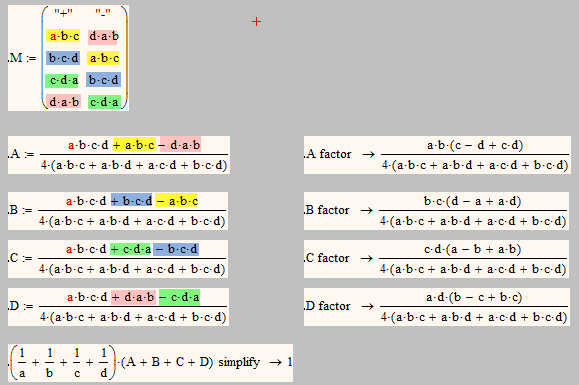
euler7.png

or using the simpler expression "a"

euler8.png

4 replies

19-Tanzanite
December 30, 2012

Are your lower case a, b, c supposed to be upper case A, B, C? If so, just make one variable equal to 1, and one variable equal to -1. Those variables then cancel each other, and the remaning varialble can be anything you want. If they are supposed to be different, then there is an infinite number of solutions.

lvl10720-TurquoiseAuthor
20-Turquoise
December 31, 2012
Many thanks for your response, Richard and Roger. They have been remained unchange. ( I have been seeking out one identity or one formula that I was very interested in ). Or :
Euler.PNG
Thanks again,
Best Regards.
25-Diamond I
December 31, 2012

Loi Le schrieb:

Many thanks for your response, Richard and Roger. They have been remained unchange. ( I have been seeking out one identity or one formula that I was very interested in ). Or :
Euler.PNG
Thanks again,
Best Regards.

Not clear what you think remained unchanged and what the real problem is. Obviously X,Y,Z have nothing to do with a,b and c, they may be given constants, right?

So with given a,b and c you may choose two variables, say X and Y, arbitrarily and easily calcute the third

31.12_2.png

Your equation could also be written as

31.12_3.png

so you are trying to find three numbers which add to a given sum. Not that difficult and by no ways unambiguous.

If you wish X, Y and Z to be integer, thats only possible if a,b and c are chosen in such a way, that the RHS fraction is integer. That given finding three integers to add up to that number should be more than easy.

So it seems that you did not stated the problem precisely enough or I am missing the point.

WE

1-Visitor
December 31, 2012

Oh, nice! That's a quick solution. Loi, you could also use the solve block to solve for it. But as Richard pointed out, there is an infinite number of solutions, so the initial guesses matter. This is just one solution.

Untitled.png

25-Diamond I
December 31, 2012

Roger Yeh schrieb:

Oh, nice! That's a quick solution. Loi, you could also use the solve block to solve for it. But as Richard pointed out, there is an infinite number of solutions, so the initial guesses matter. This is just one solution.

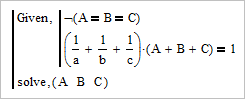
In fact every solution to the problem you solved will consist of two variables with different sign and same absolute value while the third variable may have an arbitrary value. You can see that this is the only possibility to satisfy this equation even by solving symbolically.

31.12.png

But Loi seems to be interested in another problem but I have no clue, what the role of a, b and c should be. And from the many previous posts of Loi I would guess that he (?) is interested in integer solutions, but then I may be wrong. Maybe the problem will be stated more precisely.

24-Ruby IV
December 31, 2012

Sorry, is it problem from this set of problems - http://projecteuler.net/problems ?

lvl10720-TurquoiseAuthor
20-Turquoise
December 31, 2012

It seems to be not.

lvl10720-TurquoiseAuthor
20-Turquoise
January 1, 2013

Hello, Everyone again.

And I still have related question :

So+on.PNG

Thanks in advance for your time and help.

Best Regards.

25-Diamond I
January 1, 2013

Here applies the same as before - an infinite number of solutions with a great degree of freedom: You may chose all but one of the variables A,B,C,... freely and then calculate the last one. The "symmetrical" you added would need some closer definition. I have used that expression in one of the solutions to the three variable case I posted but be aware that English isn't my primary language, too, so don't take it as a correct expression. By the way - the solution I posted is NOT symmetrical - at least not concerning the signs - look at the expression a*b*c in the nominator. Maybe what you are striving for is something about all solutions should arise from the first by cyclic permutations of the constants a,b,c,..., but then I would have to ask from where you know that solutions of that kind really exist (and I wouldn't have a clue how to find them).

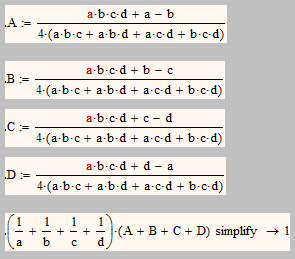
One easy method of finding solutions for as many variables A,B,C,.. you want, which look at least similar in complexity, is as follows. First transform your equation in the form A+B+C+..=... Then find the solution for the case that A=B=C=.. by simply dividing through the number of variables. You will end up with a fraction which has a*b*c*.. in the nominator. As you demand A,B,... to be all different, you may now add an arbitrary expression to one solution (I would begin with numbers 1,2,... but have chosen more complex expressions in the example below for demonstration) and subtract the same expression from another. To keep the resulting expression less complex its better to add and subtract to the nominators. Follow this procedure until you are left with zero or one solution and you are done. Symmetry enough?

euler6.png

lvl10720-TurquoiseAuthor
20-Turquoise
January 1, 2013

Many thanks for the following :

Helpful.PNG

This procedure is very helpful to me.

Best Regards.