16-Pearl
March 10, 2017
Solved

Geometry challenge

  • March 10, 2017
  • 6 replies
  • 3916 views

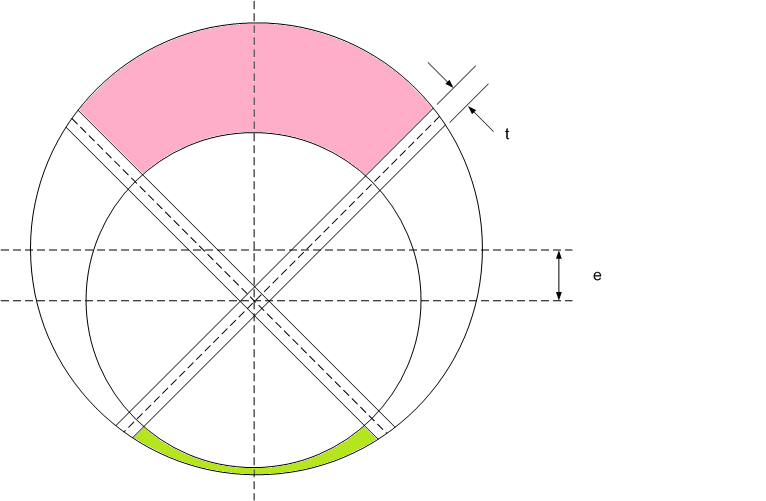
Nothing to do with Mathcad, but I know some of you enjoy a good challenge.  And I'm stumped.  Here's the situation:  Two circles of different diameters, one vertically offset a distance e from the other.  Vanes of thickness t are centered in the smaller circle.  The vane are 90 degrees from each other.  What are the top and bottom colored areas?  I'll gladly take any hints on how you'd do it.
vane.png

Thanks!

Best answer by Werner_E

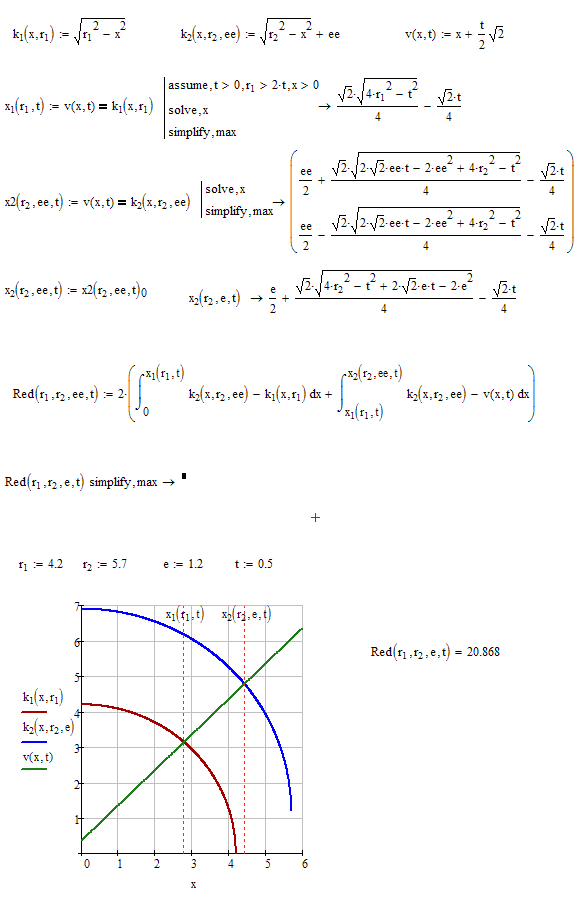
How about this brute force attack for the red area?

6 replies

Werner_E25-Diamond IAnswer
25-Diamond I
March 10, 2017

How about this brute force attack for the red area?

1-Visitor
March 10, 2017

You state that the two vanes are 90 deg from each other, but do not clarify orientation relative to the vertical offset of the circles.  Please verify that the vanes are each 45 deg from vertical.

How accurate must the answer be?  Assuming thickness t is small, is it sufficient to assume the area of a vane is equal to its length times thickness?

DJF16-PearlAuthor
16-Pearl
March 10, 2017

Sorry, the vanes are 45 from vertical (so we have symmetry).  The answer needs to be quiet exact so I'm looking for a mathematically pure result.  1% error would be unacceptable.  (It's a pump in case you're wondering.)

23-Emerald I
March 10, 2017

Need an exercise in polar coordinates.

Attached solves top half.

Bottom half is exercise for next.

1-Visitor
March 10, 2017

Hello Fred,

The lower half, would changing "ee" to:

work?

Norm

1-Visitor
March 10, 2017

How about this?

B can be determined from e & t.

Solve for A:

The second solution is negative, so use the first solution.

With A, you should be able to solve your area by addition/subtraction of circular segments and triangles.

DJF16-PearlAuthor
16-Pearl
March 10, 2017

Thanks Werner.  I knew I just wasn't looking at it simply enough.  Bottom half solution is solved by simply entering a negative eccentricity (e).  Matches my CAD answers exactly so I'm calling it solved.


I'll have to absorb everyone else's solutions also.  Thanks everyone for the efforts.

1-Visitor
March 11, 2017

Hi dferry,

although the problem is still solved, i calculated it with Prime 4.0.

A very good challenge and exercise for creating multiple Integrals.

And yes- to calculate the smaller Area there must be changed only "ey" to a negative sign.

I added an analytical solution for both Areas at the end of the Worksheet.

best regards, Volker