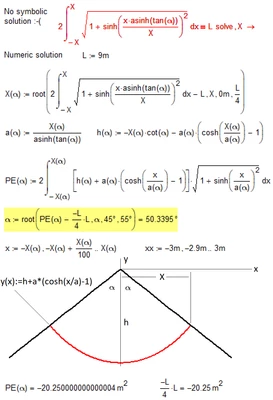
You can easily calculate the integral by hand if you remember that 1+sinh^2(a) = cosh^2 (a). Then, using real arguments, the root "cancels" with the square and as X and arsinh(tan(alpha)) are constants, simple linear substiution gives you the integral. Then you can quickly solve for X and if yo do it manually you will arrive at the very same solution which Luc had provided.
But you can also let Mathcad's symbolics di the work. As usual when it gets a little more complicated Mathcad/Mupad needs a lot of help with substitution and the placement of the right commands in the correct order.
muPad seems to prefer ln instead of arsinh and asinh is not a valid argument for "rewrite", so it looks that there is no way to convince muPad to give the solution using arsinh instead of ln.
But If you are so smart, solve please this problem symbolically until the end!
But if we do, there is no fun left for you ! 😉
Here's my attempt.
As you can see that in the last phase muPad switches to numeric mode. You may try your luck with something more capable like Maple or Mathematica, but chances are that there is not closed symbolic solution for that equation.
At least we see that the angle is constant and independent of the parameter L and the symbolics arrives at the same result as the numeric "root" function. At least sometimes. Sometimes, as I show, muPad would return results which are simply wrong! Sure a no-go - this should never happen!.
Sheet in MC11 format attached - maybe Luc is about to give it a try with Maple.
Just for fun I thought I'd see how far I could get on Valery's problem with a combination of Mathcad symbolics plus "Hand" symbolics. Like others, I found it's easy (if tedious) until trying to find where PE = -L^2/4. At this point one needs to resort to numerics. Here's my approach (in MC15):