ttokoro
21-Topaz I
21-Topaz I
November 5, 2021
Solved

How to find the answer?

  • November 5, 2021
  • 3 replies
  • 4267 views

image.pngimage.png


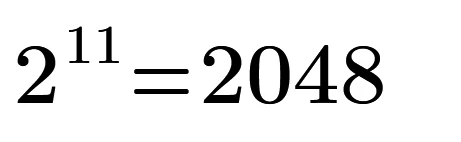
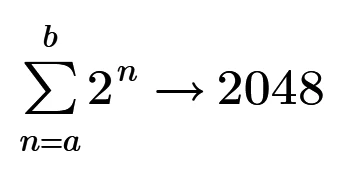
2^11 is 2048. How to find a and b? a and b are integers. 

Best answer by StuartBruff

@LucMeekes wrote:

Mathcad /Maple will not be fooled:


If you evaluate that numerically, it says 2048,

but that's due to poor (with respect to symbolic) numerical precision,

similar to the numerical results I presented above.


Luc


Yes, I'd expect that.  However, I do note that Tetsuro specifically mentioned Prime 7.


If, as I implied by my mention of infinities, you plug in -∞ to the expression in Maple you get 2048 symbolically (at least, in Maple Flow you do).


(Mathematica gives "Sum[2^n, {n, -Infinity, 10}] = 2048", as well.  I would hope Mathcad Prime 7 gives the same result?).


Stuart


(Of course, there's the thorny issue of whether -Infinity counts as an integer)


3 replies

23-Emerald V
November 5, 2021

@ttokoro wrote:

image.pngimage.png


2^11 is 2048. How to find a and b? a and b are integers. 


AFAIA, the binary expansion of any integer is unique.   


2021 11 05 A.png


Stuart

ttokoro
21-Topaz I
ttokoro21-Topaz IAuthor
21-Topaz I
November 5, 2021

Prime 7 shows another a and b. 

t.t.
23-Emerald V
November 5, 2021

@ttokoro wrote:

Prime 7 shows another a and b. 


Given the Puzzles and Games Label, I thought it might.  😈


Stuart

23-Emerald IV
November 5, 2021

Hmmm,


LucMeekes_0-1636106807423.png

Never expected this would happen.


But then, if b is a positive integer <10 then a is complex

for b=10 I get an exception due to trying to take ln(0).

for b=11 , a=11.

for b>11 a is a positive real.

Ah! b=22 gives a=23 (numerically), but:

LucMeekes_1-1636107583494.png

And with every higher multiple of 11 for b you get closer to a being b+1. for b=1012:

LucMeekes_2-1636107803468.png

and you don't even need multiples of 11 anymore. For b=1013 the evaluation gives:

LucMeekes_3-1636107877950.png

But at b=1023 the numerical evaluation fails.

LucMeekes_4-1636108053736.png


Luc

23-Emerald V
November 5, 2021

Neat. 


Something else that occurred to me in my sleep-deprived state early this morning, but which I promptly forgot about until now, was based on one of the many peculiarities of infinities.


2021 11 05 D.png


(a = -38 does the trick numerically, but I wanted to give the impression of a really large number)


I don't have a symbolic processor to hand to check its result ...


Stuart

23-Emerald IV
November 5, 2021

Mathcad /Maple will not be fooled:

LucMeekes_0-1636118929777.png

If you evaluate that numerically, it says 2048,

but that's due to poor (with respect to symbolic) numerical precision,

similar to the numerical results I presented above.


Luc

25-Diamond I
November 5, 2021

> a and b are integers

Mathcad never was able to solve diophantic equations and the symbolics ever so often ignore an "assume, xxx=integer"

Werner_E_0-1636109505281.png

You probably are aware thats its quite easy to manually arrive at the unique solution a=b=11.

Given that the sum is

Werner_E_1-1636109633320.png

with a<=b<=11, you can do as follows

Werner_E_0-1636110818942.png

Somewhat shorter:

Werner_E_0-1636120601654.png


But the shortest sure is Stuarts remark about the binary representation of a number being unique.