

Solved
From what I see you have this (assuming your formulation is correct):
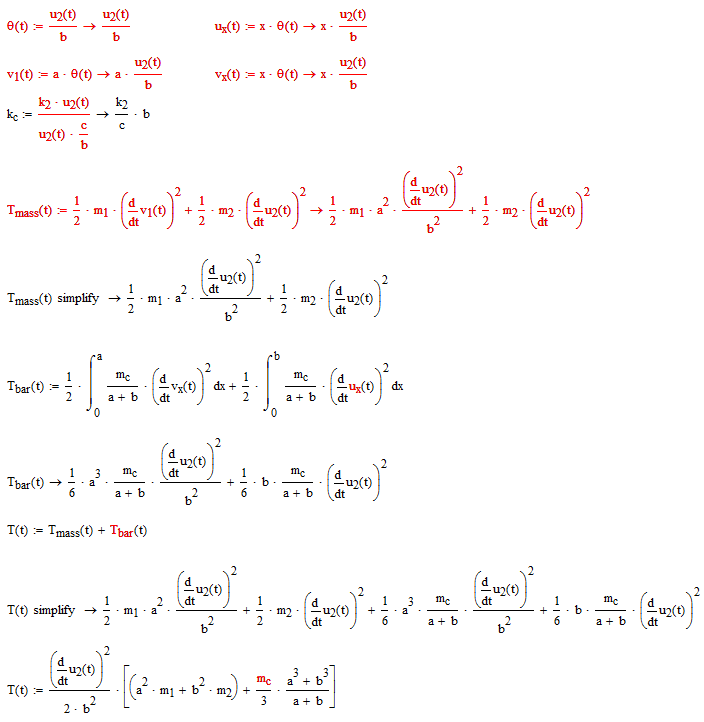
Which means you have a function T(t) which is found from the function u2(t) by first taking the derivative of u2(t) with respect to time: u'(t)=d/dt of u(t). Then square the resulting function squ'(t)=u'(t)*u'(t). Then multiply the result with a constant (assuming that a, b, and the three m's are known). This should be simple, provided that u2(t) is given...
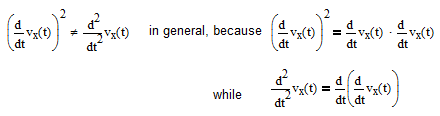
Are you sure you don't need a second derivative of any functions u and v, rather that the first derivative squared...?
Success!
Luc