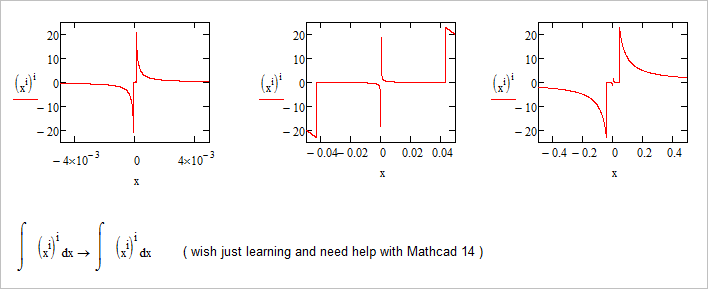
Hmmm, this not only assumes that x is real but its also only one out of an infinite number of "solutions" for (x^i)^i.
In the complex domain we run into ambiguities quite often and easy and rules for calculating with powers etc. not always apply the same way as in domain real. That was the fine thing with MC11 and Maple - it defaults to domain real and most of the time simplified expressions the same way we would do (using some implicit assumptions).
The current Mathcad's muPad can't even simplify (2^i)^i to 1/2 wheras the numerics has no problem
muPad obviously thinks more complex (pun intended):
and so we have multiple ways to express (x^i)^i and Mathcad can't simplify to the one with k=0. I'd wish that MC would at least give the simplification similar to my expression. Mathcad will usually do so with "solve,fully" but in this case with no success
We can "verify" the multiple "solutions" with the numerics (the symbolics again is of no help, possibly again as of other ambiguities)
Just noticed that also Mathcads numerics does NOT simplify that expression to 1/x. Thats the reason for the strange lookin plots with all its jumps
What motivates these questions of yours?
Yes, this would also be of interest to me. Loi Le is around here for some years with his special questions and I also asked few times about the reason or the source of his various problems but unfortunately never got an answer.
Hmmm, this not only assumes that x is real but its also only one out of an infinite number of "solutions" for (x^i)^i.
Quite right. But, at best, Mathcad is never going to give more than the simplest solution to these sort of questions (any more than it gives an infinite number of solutions to arcsine(theta), say), so I stuck to the simplest!
That said, your reply is likely to be more useful than mine to Loi Le if he's just trying to educate himself about these relationships - where just relying on software could be misleading.
It seems you didn't really understood my remarks about the mathematical ambiguity of the function in question and the way Mathcad deals with it and I honestly can't think of anything better to explain than the plot in my last post.
I already showed that from the mathematical point of view we have
So your equation has an infinite number of solutions:
Mathcad (practical math??) will give you just the two solutions +1 and -1, depending on the guess value you provide. For some guesses you may even get 23.141 (=exp(1*pi)) because Mathcad ran into some kind of numerical inaccuracy.
I guess that this will be my last reply to this and "related" "problems".