
Integration as Summation
Dear All,
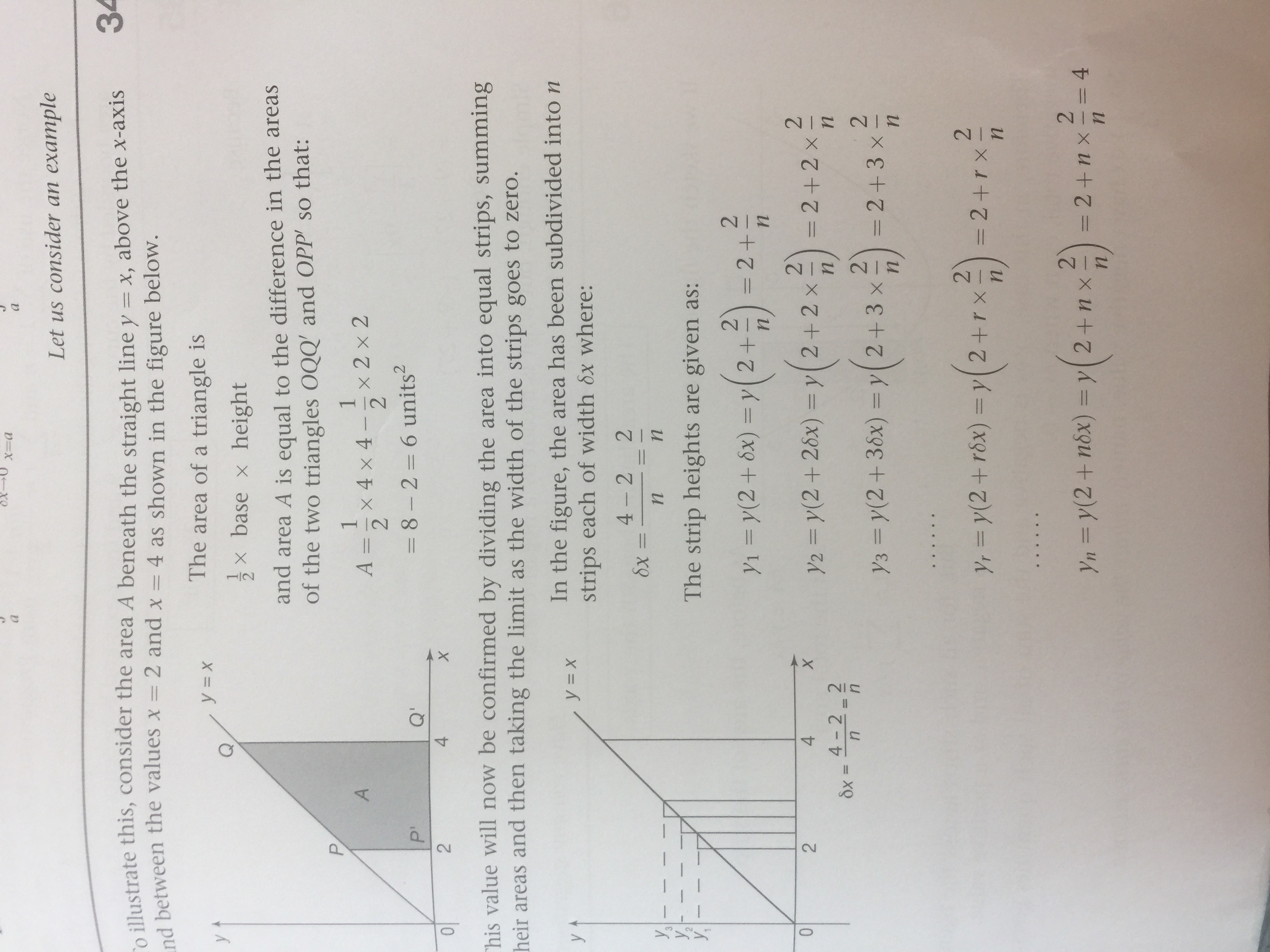
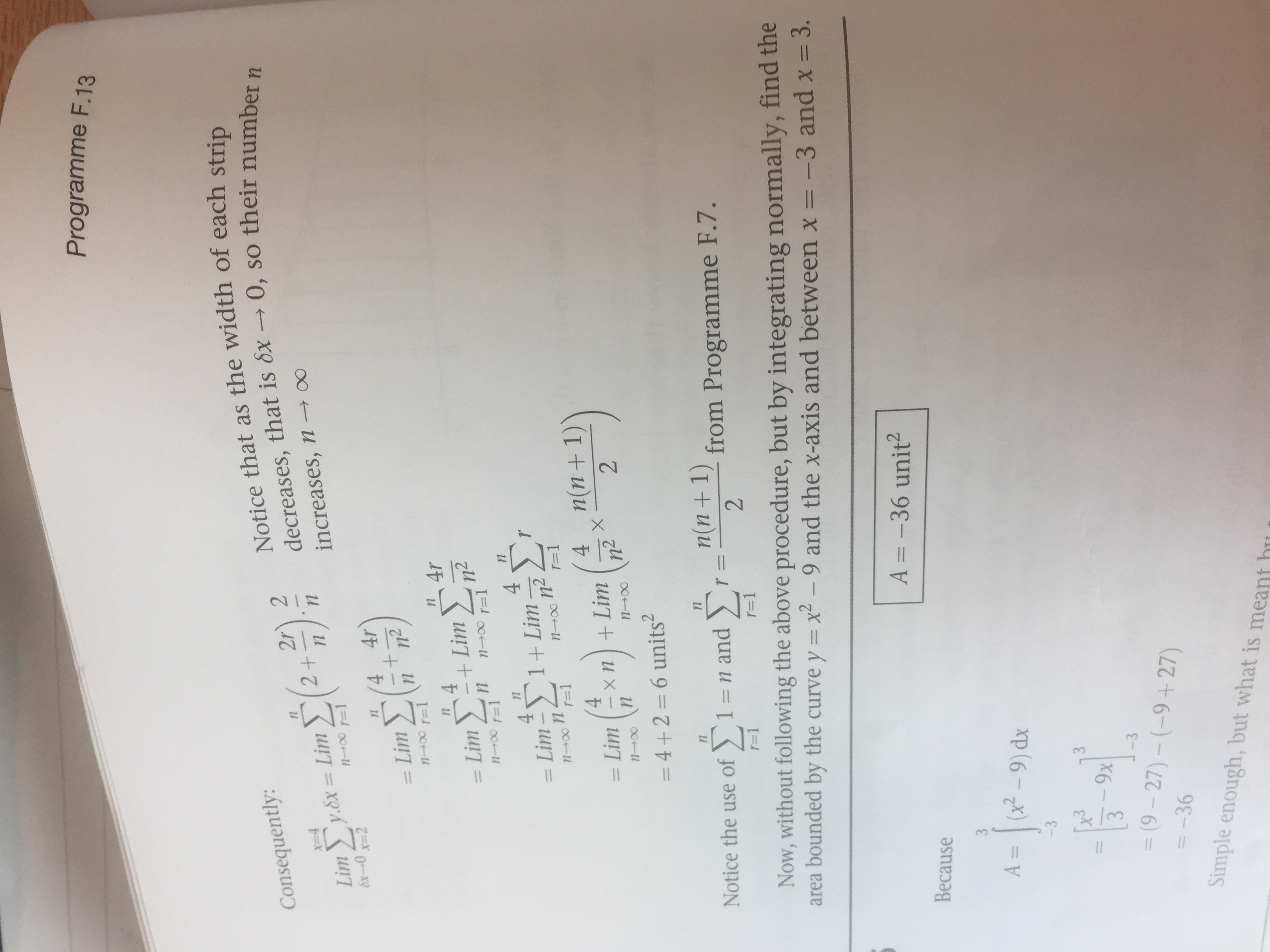
I am again coming to you with an issue I have related to work I am doing from a text book this time on the topic of integration as summation. The text book is trying to prove that integration is essentially the summation of an infinite number of rectangles. I have inserted images of the text in question as this is easier (sorry for this being sideways).
The example looks at a simple graph of y=x as seen in the below images. The problem I am having is I understand the concept, indeed I know that to find the area under the line y=x can be derived algebraically by integrating x to give x^2/2 and calculating for x=4 and x=2 and taking one from the other to get an area of 6 units^2.
However, following the example in the text book in the second image I can't see how the penultimate line of lim n to infin 4/n *n + lim n to infin 4/n^2*n(n+1)/2 gives 4 + 2 = 6. I can see that 4/n*n will give 4 as the ns cancel but on the other side I see that 4/n^2*n(n+1)/2 should give 4n^2+n/2n^2 would leave 2+n i.e. the n^2s cancel 4/2 is 2 and there is a remaining n.
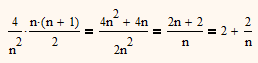
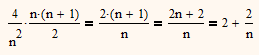
I have used Mathcad to confirm my assumptions but Mathcad's symbolics indicate that the top expression in the second image below does give 6 but the bottom expression does not it gives 4 + 2 * lim n to infin n(n+1)/n^2.
Can anyone tell me if I have misunderstood something or if the text book is wrong? I presume this is the former not the latter.
Cheers,
Andy