11-Garnet
December 13, 2015
Solved

interpolate

  • December 13, 2015
  • 1 reply
  • 3189 views

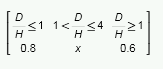
Any one can help me to interpolate the value of x

Thank you.

D:24m

H:8m

Best answer by Werner_E

Lex Dante wrote:

Yes D/H is a ratio  and the condition is like this,
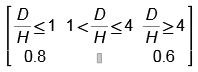
Now your "table" is more meaningful.

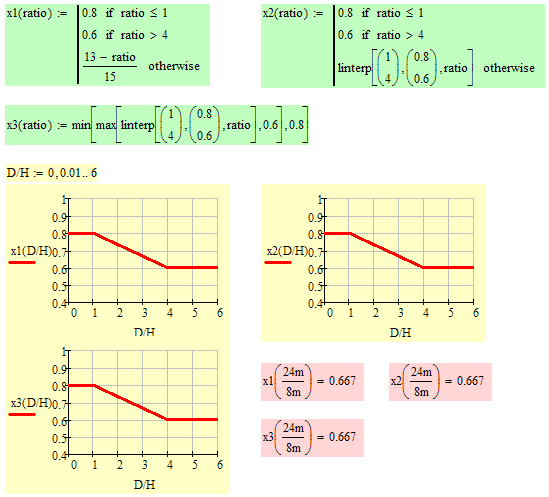
I guess you are looking for something like the attached.

You can use "if" and "otherwise" (in Mathcad 15 and below) statements for the out-of-range values and can manually interpolate the values between 1 and 4 (function x1) which is easy enough  or you can let Mathcad do the interpolation for you (function x2).

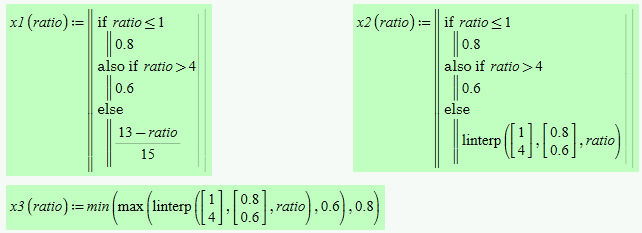
In Prime you would use if, also if and else and it would look more cluttered. You may also use return statements to avoid the nesting of if's, etc -> see function x2b.

You may also let max and min do the "cutting off" of the values which are out of range as in function x3, but I guess thats a bit harder to read.
Implementation in Prime:
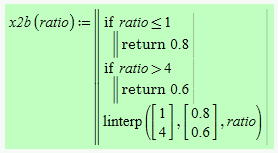
Regards

Werner

1 reply

23-Emerald IV
December 13, 2015

It's a bit hard to see but: are those ratio's of D and H?

Then for D/H=1, the leftmost AND the rightmost conditions apply: the value on the lower line must be at the same time 0.8 and 0.6.

I see no way to interpolate x.

Success!
Luc

ldante11-GarnetAuthor
11-Garnet
December 13, 2015

Yes D/H is a ratio  and the condition is like this,

Werner_E25-Diamond IAnswer
25-Diamond I
December 13, 2015

Lex Dante wrote:

Yes D/H is a ratio  and the condition is like this,

Now your "table" is more meaningful.

I guess you are looking for something like the attached.

You can use "if" and "otherwise" (in Mathcad 15 and below) statements for the out-of-range values and can manually interpolate the values between 1 and 4 (function x1) which is easy enough  or you can let Mathcad do the interpolation for you (function x2).

In Prime you would use if, also if and else and it would look more cluttered. You may also use return statements to avoid the nesting of if's, etc -> see function x2b.

You may also let max and min do the "cutting off" of the values which are out of range as in function x3, but I guess thats a bit harder to read.

Implementation in Prime:

Regards

Werner