15-Moonstone
May 31, 2022
Solved

Intersecting Planes

  • May 31, 2022
  • 1 reply
  • 3612 views

Hi,


I'm trying to figure out the math for something that I did in CAD. Eventually, I have to code it in Fortran. However, I thought I should try in Mathcad first. I found some websites and tried to use the information they provided. For their inputs, I get their answers. However, when I try to use the real inputs from the CAD model it's way off and doesn't seem to make any sense. I'm not sure what I'm doing wrong. This isn't a Mathcad issue, just me trying to figure out the math.


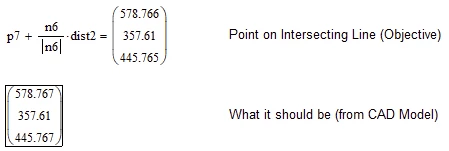
From what I can tell this is the point normal form of intersecting planes. I actually know what the surface normals are. But the values I'm getting from the math don't match at all. Ultimately, I need to figure out the angle between the intersecting line and the local xy plane (rather than the global xy plane). I tried to provide some pictures. I have triple checked my inputs and don't see any issues there. I suspect my math is not right, but I have no idea why.


Anthony

 

Best answer by Werner_E

Its unclear to me what your three picture should show and it sure would help if you would describe what exactly you a re trying to calculate in your Mathcad sheet.


BTW, to apply a certain distance (dist1:=2 in your sheet) along a direction (possibly n3 in your sheet) you have to use the unit vector in n3 direction (n3/|n3|). The point you calculated sure IS a point on the intersection line of the planes (P1,P2,P3) and (P1;P5,P6) but its distance from P1 sure is not 2 but something in the range of 1034.


n4*(p8-p7) should be zero and what you experience are round-off errors. Not sure why you call it "way off". You may set the zero threshold from the default 15 down to 12 to see a nice zero here 😉


Afterthought: I guess your problem can be solved by simply using the unit vector as described above:

Werner_E_0-1654044394157.png


1 reply

Werner_E25-Diamond IAnswer
25-Diamond I
June 1, 2022

Its unclear to me what your three picture should show and it sure would help if you would describe what exactly you a re trying to calculate in your Mathcad sheet.


BTW, to apply a certain distance (dist1:=2 in your sheet) along a direction (possibly n3 in your sheet) you have to use the unit vector in n3 direction (n3/|n3|). The point you calculated sure IS a point on the intersection line of the planes (P1,P2,P3) and (P1;P5,P6) but its distance from P1 sure is not 2 but something in the range of 1034.


n4*(p8-p7) should be zero and what you experience are round-off errors. Not sure why you call it "way off". You may set the zero threshold from the default 15 down to 12 to see a nice zero here 😉


Afterthought: I guess your problem can be solved by simply using the unit vector as described above:

Werner_E_0-1654044394157.png


15-Moonstone
June 1, 2022

thanks a lot. you figured it out. sorry the pics aren't clear. it's hard to even understand in cad let alone get a good screen shot. i wasn't referring to the round off error. but the normals coming out were not even close to the values i had in cad. ironically, i had previously tried your fix on the cad values but it never occurred to me to try on the values from the math. i'll try that next. i suspect they will match now.


update;

the only problem remaining is the normal vector of the surface, from the math, still isn't matching what i have in cad. the part where i said  they aren't even close refers to n4 compared to n4a or n4b. also n5 vs n5a or n5b. the difference in a and b was direction. i tried the opposite of what i thought the normal was in cad. but that is only changing the signs. the magnitudes are what are way off. if i use what you showed on n4 and n5 they still don't match. i'd like to figure that out since it would be a lot easier for me to use the known normals than to calculate them from the points.

15-Moonstone
June 1, 2022

oh, i got lucky and figured it out. if i use what you showed and multiply by the known length of the surface normal it then matches. so i can now get n4 to match 4a and n5 to match n5a. this will let me continue. thanks for your help. i guess in what i was reading, the definition of surface normal wasn't what i thought it would be. their definition comes out with units of meters squared. so that let me figure out the problem. if i divide by the magnitude to get a unit normal and then multiply by the known normal length, i get the agreement i was looking for.


i attached an updated version, in case it helps anyone.