Best answer by Werner_E

@Cornel wrote:

I think this happens because of that constant which normally is added in the indefinite integral calculation:

CornelBejan_0-1675324435951.png


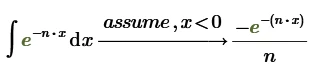
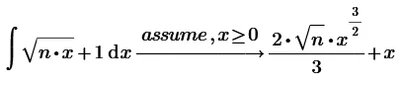
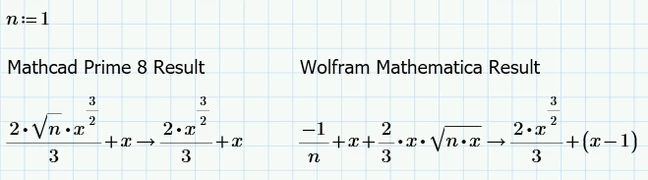
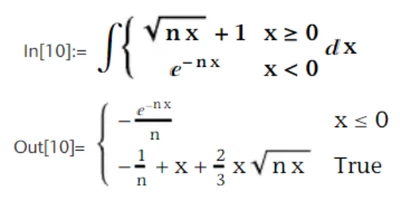
Correct.  And if a software by default ignores/omits that constant of integration in indefinite integrals, it also should omit that summand 1/n. So Prime is also a bit more "correct" here because its result for this integral also covers correctly the case of n=0 whereas the results of Mathematica is wrong and invalid for n=0.


As for the other integral I am disappointed that neither software considers the case n=0 and simply ignores it!

 

1 reply

Cornel19-TanzaniteAuthor
19-Tanzanite
February 2, 2023

I think this happens because of that constant which normally is added in the indefinite integral calculation:

CornelBejan_0-1675324435951.png

Werner_E25-Diamond IAnswer
25-Diamond I
February 3, 2023

@Cornel wrote:

I think this happens because of that constant which normally is added in the indefinite integral calculation:

CornelBejan_0-1675324435951.png


Correct.  And if a software by default ignores/omits that constant of integration in indefinite integrals, it also should omit that summand 1/n. So Prime is also a bit more "correct" here because its result for this integral also covers correctly the case of n=0 whereas the results of Mathematica is wrong and invalid for n=0.


As for the other integral I am disappointed that neither software considers the case n=0 and simply ignores it!