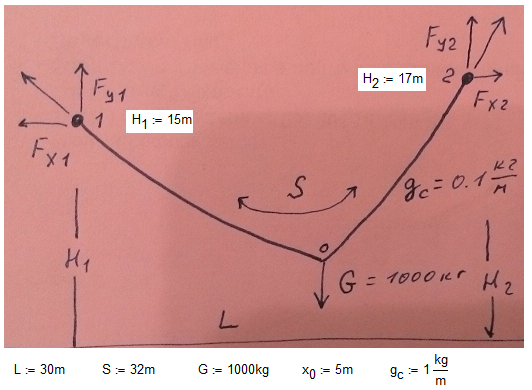
Best answer by ValeryOchkov

Werner Exinger wrote:

Many good people in the past were victims of what they believed to be common sense

But in 99.9..% cases common sense = science!

I'd be happy to be able to believe the solutions will be catenaries, so maybe you can explain how a linear function can be a special case of a catenary,

Sorry, no a linear function a+b x, but I tell about a catenery like, near straight line!

I think this massage #100 is a dead point of this discussion. I would like to begin new one in new branch of this forum Or on one other Math forum. On one forum, where man does not say "I feel it is not correct, bu I do not know why!"
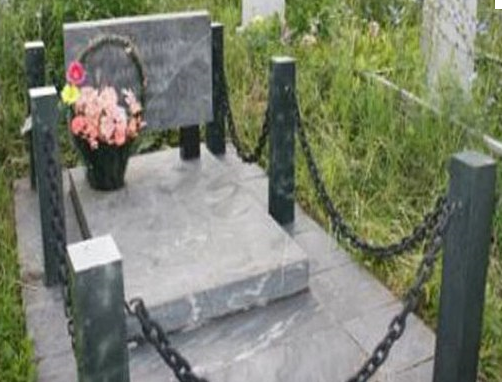
Grab.png

6 replies

25-Diamond I
October 27, 2013

Valery, the catenary came up here in the forum quite some many times and I guess you were involved in most if not all of those discussions 😉

Jan sent a very pretty video made with Blender (Mathcad animation can't cope with that) here: http://communities.ptc.com/message/198322#198322

Maybe Richards fine solution to a much more sphisticated and complex problem may help you. Its in the same thread here: http://communities.ptc.com/message/199100#199100

24-Ruby IV
October 27, 2013

Werner Exinger wrote:

Valery, the catenary came up here in the forum quite some many times

Thanks, Werner, I know this solutions.

But I would like to use more simple Method - the block Given-Find for new solution.

And do not know is it possible!

25-Diamond I
October 27, 2013

You you already assume that the left and right part are catenaries.

Just a quick idea (without closer thinking about): Lets look at the left side. This catenary has its (imaginary) lowest point at x01. Somewhere between Point 1 and this lowes point is the weight G. Shouldn't the weight of the chain from the point of the weight G and its lowest point (x01, that is the weight of the chain that doesn't exist) be the same as G?

At first sight I stumbled over the assumption Fx1=-Fx2 but i seems to be OK, I guess.

23-Emerald I
October 28, 2013

In a catenary, the horizontal tension is constant.

You can develop enough equations to find a solution.

24-Ruby IV
October 28, 2013

Fred Kohlhepp wrote:

In a catenary, the horizontal tension is constant.

Yes - in the point 0 too

Thanks, Fred. I have lost my dream...

But change please H1, H2, G etc and see the plot.

23-Emerald I
October 28, 2013

I don't see a problem. You can set up the solve block as a function.

23-Emerald I
November 1, 2013

Half a problem.

24-Ruby IV
November 2, 2013

Fred Kohlhepp wrote:

Half a problem.

Thanks Fred for the support!

"To be or not to be? That is the question!"

I think we can show it without DE - with a simple logic.

I see a part of chain:

Chain1.png

It may be so

Chain2.png

or so (the load is fixed or very slow moves).

Chain3.png

Or?

25-Diamond I
November 2, 2013

Valery Ochkov wrote:

I think we can show it without DE - with a simple logic.

I see a part of chain:

OK. What is it we should see? I guess you mean we see an ordinary catenary, right?

It may be so

OK.

or so (the load is fixed or very slow moves).

No! Not OK. You already assume that a single point load generates a catenary to "show" that a single point load generates a catenary.

You can easily prove that the square root of 16 is 5 if you first assume that 5^2 is 16.

Thats TOO simple logic 😉

24-Ruby IV
November 2, 2013

Allen Razdow (the author of Mathcad) has said me that in Boston or Cambridge is one building with the walls as cateneries.

I think it is our problem in Australia (two parts of an arch):

AustOpera.png

You can turn your notebook or tablet in ailartsuA and see a catenary

ailartsuA.png

25-Diamond I
November 2, 2013

I think it is our problem in Australia (two parts of an arch):

No, but its very often read that the Sidney opera house shells form a catenary. Its not true. The architect Utzon himself had changed the construction using his "spherical solution".

Also the original ceiling of the concert hall consisted of reverse catenaries but the design had to be changed (I think that was made after Utzon left Australia, but I'm not sure about that) because of acoustic problems.

Some readings:

[1] Daryl Dellora, Utzon And The Sidney Opera House, Pinguin Special

[2] http://www.fpv.umb.sk/kat/kf/Integrovana_prirodoveda/SG/Zvuk/Sluch/Online_Course_on_Acoustics/opera_house.html

Citation from [1]: "This posed the conundrum of what kind of form should be employed for the shells. Should it be an ellipsoid? A parabola? A catenary? Work on this difficult mathematical problem took up thousands of hours of the engineers' time and expertise - a staggering 150,000 hours by February 1962 - and yet after two years they were no closer to resolution. Finally Utzon solved the problem himself: with a unique mix of aesthetics and mathematics, he developed his famous 'spherical solution'.

At its simplest, this meant that every element in each of the shells would be taken from a sphere of the same radius. It followed that the manufacture of these elements could then be done uniformly and cheaply. The spherical solution also carried with it the solution to another perplexing issue, the question of the

shape of the tiles that were to cover the shells. Once the curvature of the shells was determined to be spherical, it followed as rudimentary geometry that the tiles should be square."

Citation from [2]: "The original ceiling consisted of large 'reversed' arches shaped like catenaries hung longitudinally from the external shell [cf: Figure 1]. However, model testing showed that the orchestra area suffered from a deficiency of early arriving sound meaning that the direct sound dominated over the early reverberant sound and the influence of lateral reflections was negligible. Adding suspended reflectors over the stage did not substantially change this situation. It was therefore decided to raise the ceiling substantially and reduce the distance between the side walls."

24-Ruby IV
November 4, 2013

When I have worked with this task I have one idea - see http://communities.ptc.com/docs/DOC-4579

What you think about it?

24-Ruby IV
November 5, 2013

This is called 'An exhumation of the problem" - see http://communities.ptc.com/message/225463

Grab.png