1-Visitor
May 24, 2016
Solved

Problem with units on solve blocks

  • May 24, 2016
  • 7 replies
  • 4336 views

Hello,

I'm realtively new to MathCAD Prime 3.1. In my previous works I used MathCAD 14 but with this one I can't make this work. Especially the units.

Basically, I just want to solve a system of two equations and I can't make this work right. That's why I need some help from you guys. I've searched a lot here, but the problem remains.

At the end of the attached file there are two solve blocks. I want to solve them both, so in each one I do: Find(W_L1,R1), for example, to obtain result of the system, but MathCAD can't do that for me and I don't understand why. If I eliminate all the units and try to solve them, I think it does the math. Although, as this is part of my thesis work, I want everything right, including the units, that are essential.

Thank you in advance for your time.

Regards!
Best answer by -MFra-

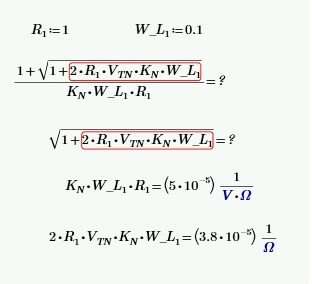
Something is wrong in the formulas. (Assuming that the units of measure, which I attributed to R1 and W_L1, are the right ones)

4eq.jpg

On the other hand, leaving everything unchanged, something is wrong as well:

4eq1.jpg

Also the number 1 under the radical should be sized (1S)

7 replies

19-Tanzanite
May 24, 2016

Many of us can't read a Prime 3.1 file. Please post a pdf.

24-Ruby III
May 25, 2016

Richard,

You can find it in attachment.

24-Ruby IV
May 24, 2016

Do you want to solve ODE?

I think you must use the derivative operator and the function with one argument T

25-Diamond I
May 24, 2016

Not using the derivative operator is just one of the problems.

You should define your function V.CTAT using := before the solve block.

Also you should define the derivative you want to use as a function before. But you seem to take the derivative with respect to a variable T the function is not depending on - so the derivative would be zero! probably not what you intended.

Furthermore you have a lot of unit mismatches, e,.g.

V.TN*K1/V.TN would be dimensionless, but the derivate would have the unit volt divided by unit of T

In the nominator you try to add three summands - each of which has a different unit. Obviously this can't work.

Are you sure that R1 should be dimensionless? If not, you would have to provide the correct unit with the guess, too.

WE

-MFra-21-Topaz IIAnswer
21-Topaz II
May 26, 2016

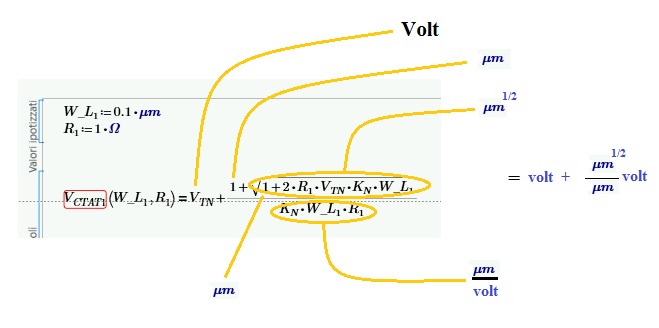
Something is wrong in the formulas. (Assuming that the units of measure, which I attributed to R1 and W_L1, are the right ones)

4eq.jpg

On the other hand, leaving everything unchanged, something is wrong as well:

4eq1.jpg

Also the number 1 under the radical should be sized (1S)

dguerra1-VisitorAuthor
1-Visitor
May 27, 2016

Thank you so much for your help guys!

Yes, something was wrong with the expression, as I was not using the value of T on the equation. Basically, I want to study how the voltage V.CTAT1 varies with temperature T. Then I have to do the same thing for another V.CTAT2 (in series) and dimension the relation W/L in order to achieve temperature independence, because I want to have a voltage reference that is independent of the temperature coefficients.

W_L.1 is the ratio between Width and Length of the transistor, so it is unit less. R1 is the value of a resistor that I can vary "outside the box" and T is the range of temperature from 0 to 100 degrees. I think I have something here now:

Capture2.PNG

Capture.PNG

The expression above is directly used from a paper, by the way.

I have another question: The graph you see is for a value of W_L.1 equals to 10. I want to do the same thing for different values, like 20, 30, all the way to 100, and trace all the results in the same plot. Is there anyway of doing that, without "rewriting" the expression ten different times, with ten different W_L values? For example, I want to have something like this:

Id(Vgs)_TFT_Flex_Diode_Vd10V_Vg10V_ParametricW.png

19-Tanzanite
May 31, 2016

Make V.CTAT1 a function of W_L.1 as well as T, and then just call it with different values of W_L.1

dguerra1-VisitorAuthor
1-Visitor
May 31, 2016

No one?

dguerra1-VisitorAuthor
1-Visitor
May 31, 2016

Thank you, Richard!