ttokoro
21-Topaz I
21-Topaz I
January 12, 2023
Solved

Puzzle 28 Find the most far point from [0 0 0].

  • January 12, 2023
  • 3 replies
  • 6569 views

Make 1 ohm by 1 ohms is my best electric circuit puzzles.

I show the 1D, 2D and 3D lattice answers. Maybe these are the only one solution for each dimension.  
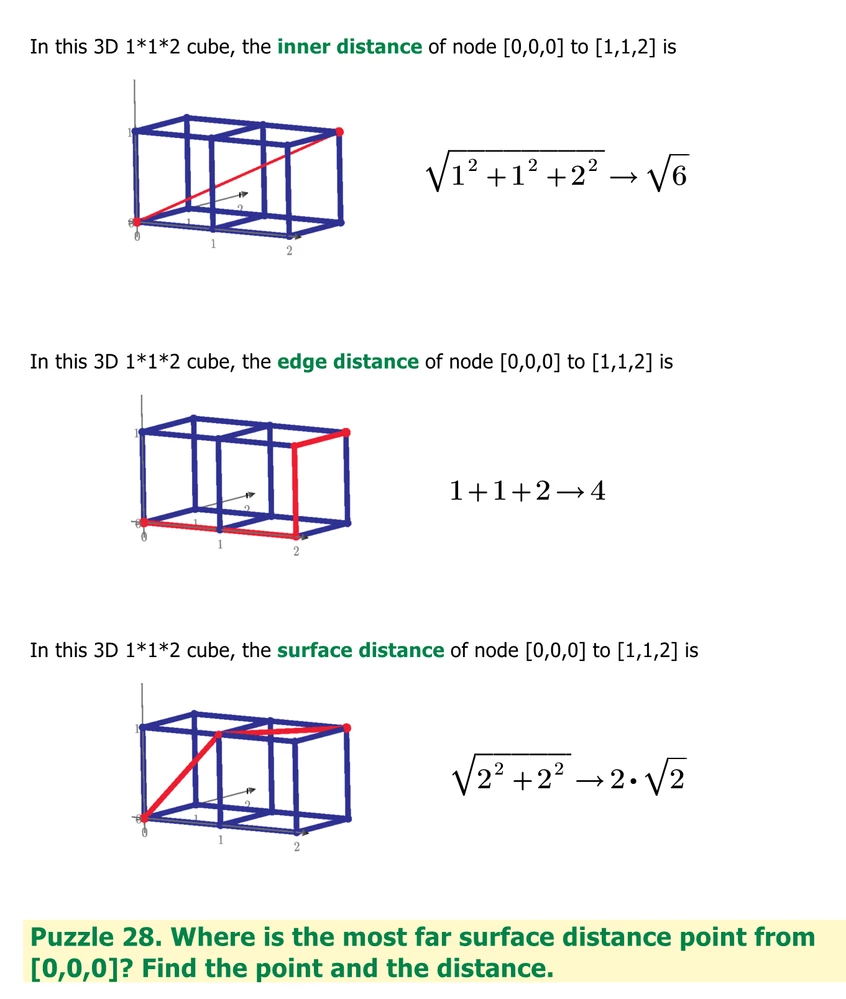
Puzzle 28 is using this 3D lattice shape 1*1*2. Where is the most far surface distance point from [0,0,0]?

Find the point and the distance.
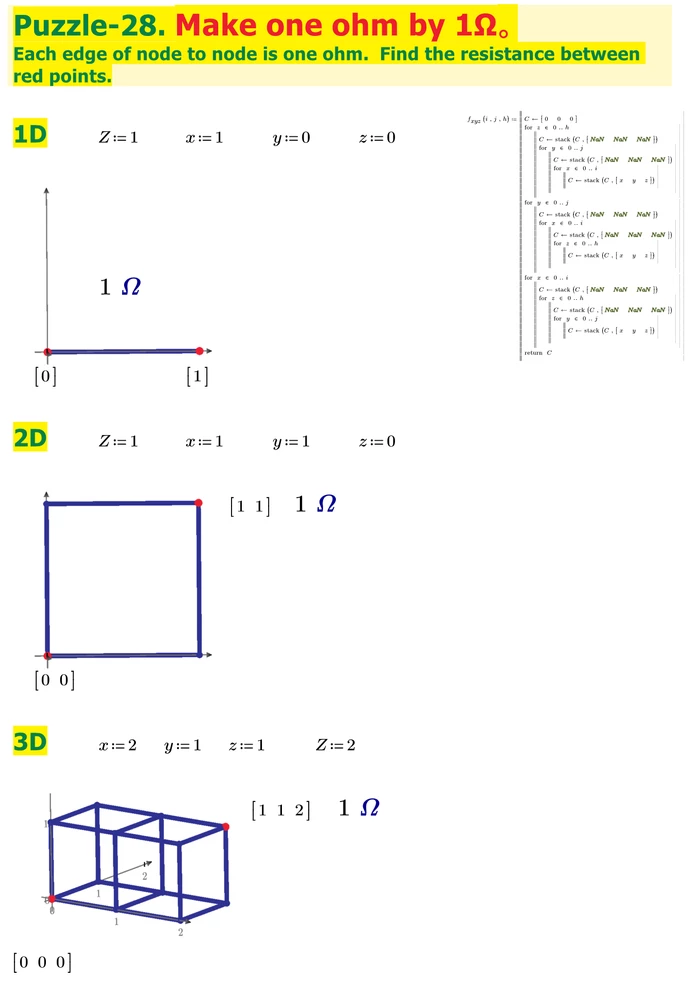
image.pngimage.png

Best answer by Werner_E

@ttokoro wrote:

For the 3*4*5 cube, the surface distance of [0,0,0]-[3,4,5] is.

image.png 


Yes, but.... I thought the task is to find the point with the largest surface distance from (0;0;0) in a 1 x 1 x 2 cuboid.

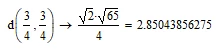
And I would say that (0.75; 0.75; 2) would be a good candidate:

Werner_E_0-1673687161968.png

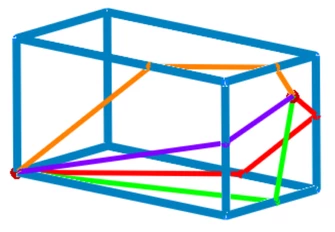
There are four possible ways from (0;0;0) to (0.75; 0.75; 2), all the same length!

Werner_E_0-1673702430981.png


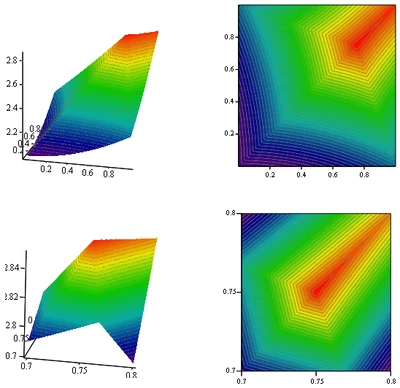
But I am missing a true proof that its really the point with the largest distance. I just have a numerical

Werner_E_1-1673687972959.png

and an optical confirmation

Werner_E_3-1673688831167.png


3 replies

25-Diamond I
January 12, 2023

The 3D object you show consists of line segments only. You will have to define what exactly you would like to call a "surface" and how exactly you would like to define "surface distance" of two "points". I assume that with "points" you only mean the endpoints of the line segments.

ttokoro
21-Topaz I
ttokoro21-Topaz IAuthor
21-Topaz I
January 12, 2023

In this puzzle, surface means the surface on the 1*1*2 cube as shown below in blue color. 

Point means any point on the surface and not only the integer nodes.

Distance means the shortest way by connecting two points by string on the surface. 

image.png

t.t.
23-Emerald IV
January 12, 2023

That could be any point on the block, depending how many times you want to go around.

Limiting myself to go from 0,0,0 to 1,1,2, I could also go from 0,0,0 to 0,1/2,2, and from there to 1,1,2, then the 'surface distance is:

LucMeekes_0-1673557025189.png

or go from 0,0,0 to 0,1/3,2 and then on to 1,1,2, which gives:

LucMeekes_2-1673557243029.png

better still, choose any fraction delta and go via 0,delta,2 to 1,1,2 gives at maximum:

LucMeekes_3-1673557455535.png

all of which is more than

LucMeekes_1-1673557079055.png


Luc

ttokoro
21-Topaz I
ttokoro21-Topaz IAuthor
21-Topaz I
January 12, 2023

Thanks. Sorry my explanation is poor.
Start point is fixed to [0,0,0]. End point is not fixed to [1,1,2] but any point on the surface. So, find the most far point on the surface from [0,0,0].

The surface distance from [0,0,0] to [1,1,2] is "the shortest way" on the surface and it is 2*sqrt(2).  

(The surface distance from [0,0,0] to [1,1,1] is "the shortest way" on the surface and it is sqrt(5).)

Tokoro.

t.t.
25-Diamond I
January 13, 2023

So the surface distance from (0;0;0) to (1;0.8;2) is 1/5*sqrt(221)=2.973...  ?

Werner_E_0-1673576574913.png


ttokoro
21-Topaz I
ttokoro21-Topaz IAuthor
21-Topaz I
January 14, 2023

For the 3*4*5 cube, the surface distance of [0,0,0]-[3,4,5] is.

image.pngimage.png 

t.t.
Werner_E25-Diamond IAnswer
25-Diamond I
January 14, 2023

@ttokoro wrote:

For the 3*4*5 cube, the surface distance of [0,0,0]-[3,4,5] is.

image.png 


Yes, but.... I thought the task is to find the point with the largest surface distance from (0;0;0) in a 1 x 1 x 2 cuboid.

And I would say that (0.75; 0.75; 2) would be a good candidate:

Werner_E_0-1673687161968.png

There are four possible ways from (0;0;0) to (0.75; 0.75; 2), all the same length!

Werner_E_0-1673702430981.png


But I am missing a true proof that its really the point with the largest distance. I just have a numerical

Werner_E_1-1673687972959.png

and an optical confirmation

Werner_E_3-1673688831167.png


ttokoro
21-Topaz I
ttokoro21-Topaz IAuthor
21-Topaz I
January 15, 2023

image.pngimage.png


Then, the last question is what is the largest surface distance  on a 1 x 1 x 2 cuboid?

It means we need two points on the surface and the distance is larger than above result.

t.t.