I guess the iteration should be sligthly different, but the main problem seems to be that the initial value for x1 and y1 are chosen in a way, that the RHS of the inequality would already yield a result greater than N if p1,p2 and p2 would be calculated the same way as shown in the iteration loop. So the iteration runs exatly one step and stops when that RHS is approx 10.7...
Solution could be to chose larger initial values for x1 and y1.
Find attached a routine which outputs a table so you can watch the values change. You will have to find suitable start values for x1 and y1.
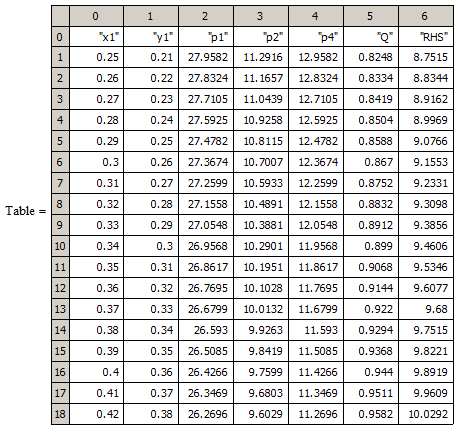
But is it really mandatory that both x1 and y1 are changed the same way (-0.01)? I guess you are simply trying to search for values x1 and y1 which makes the RHS equal to N.
If thats true, so why not try a solve block:
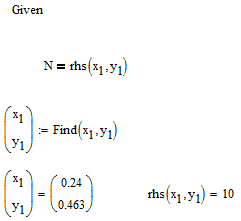
Thats only one of an infinite number of solution pairs, so you could add some appropriate constraints like
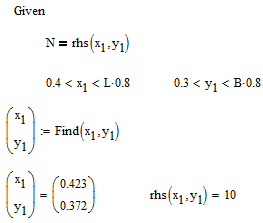
or
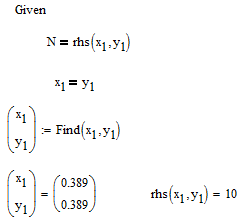
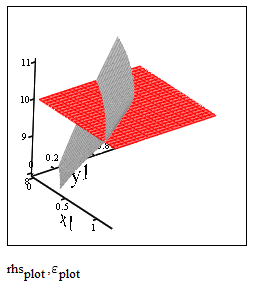
Basically your RHS represents a surface in 3D which you have to intersect with the plane at height N:
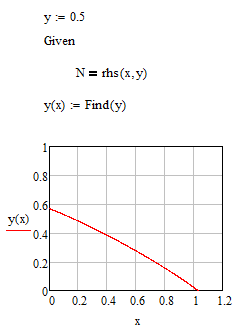
The curve of intersection can also be drawn as a 2D plot, y1 over x1:
BTW, John Smith, isn't this question related to this one of John Air: http://communities.ptc.com/message/240228#240228 ?
