Jason,
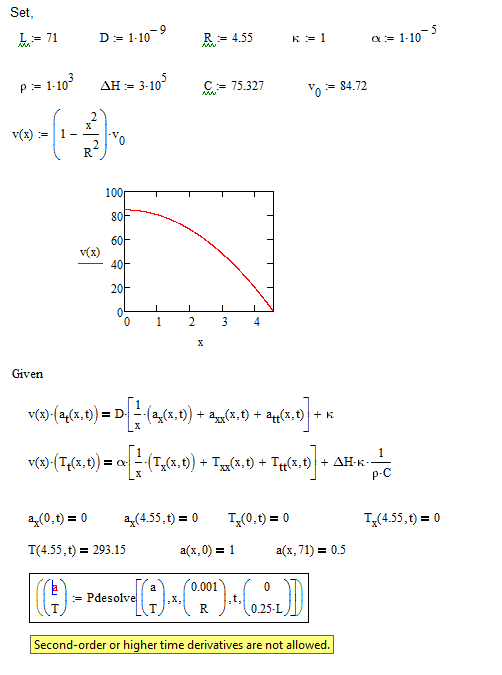
your differential equation problem is somewhat weird.
First off: you have two differential equations, one entirely in terms of the function a(x,t) and its (partial) derivatives, the other entirely in terms of the function T(x,t) and its (partial) derivatives. This leads me to think that you can solve a() and T() separately.
Then observe that the two differential equations are the same, except for some constants: alpha instead of D, and kappa versus kappa multiplied with and divided by some constants. This would mean that the two functions a() and T() will (probably) be the same except for some constants.
Now for a() you have 4 boundary conditions, but for T() you only have 3. Either 4 is too much for a(), or 3 is too few for T(), or they're both off.
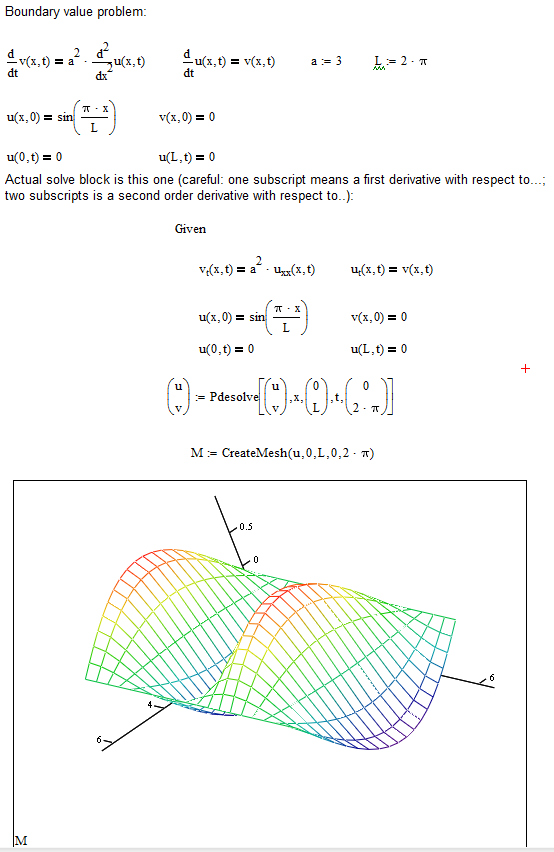
I experimented a bit to see if I could solve the problem symbolically. Here's the result:
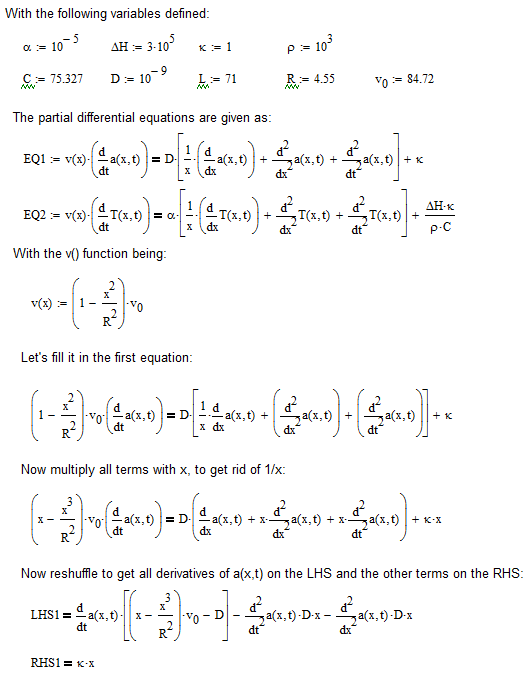
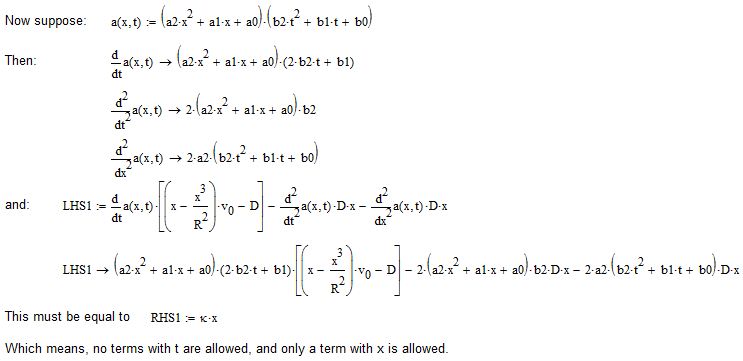
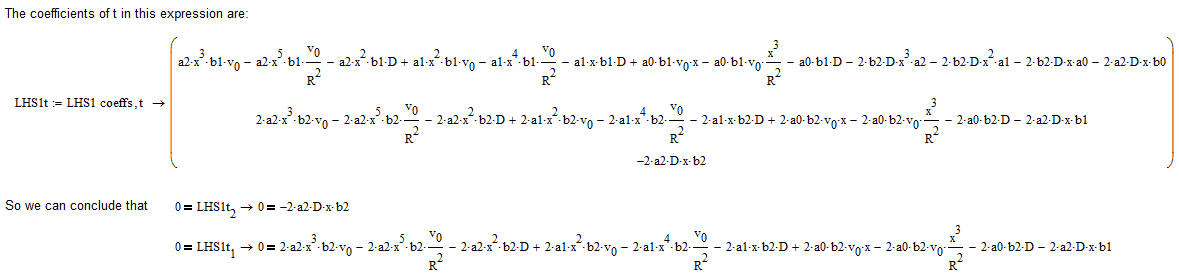
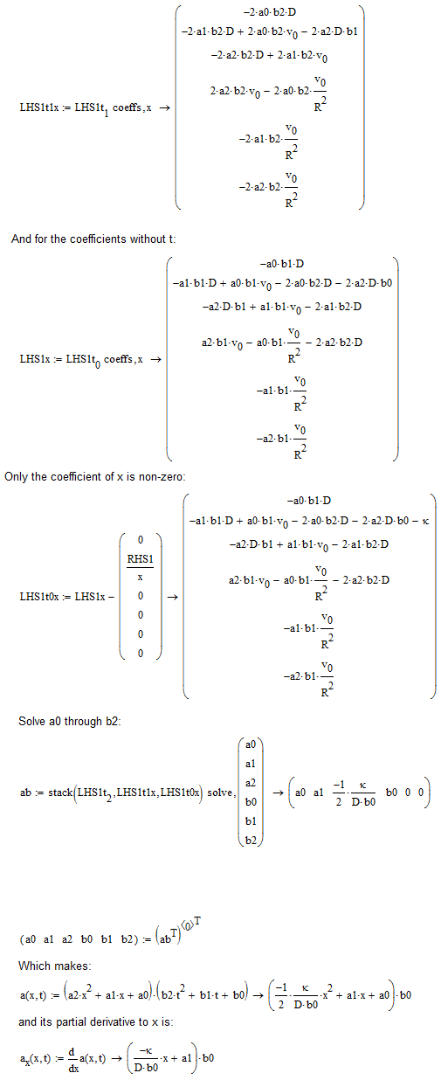
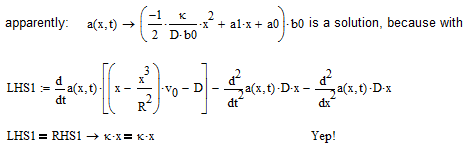
Unfortunately the values of a0, a1 and b0 cannot be solved in terms of the defined variables,
using the boundary conditions:
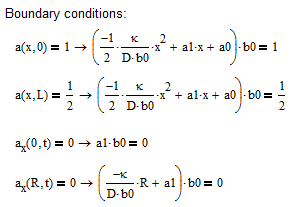
(from the 3rd equation, either b0 or a1 must be 0.
If b0=0, then the fourth will also hold, but the first two equations will not hold.
If a1=0, then the fourth can only hold when also b0=0...
The LHS's of the first two equations are equal, but the RHS's aren't, 1=1/2?)
Are you sure the problem is well formulated?
Luc