20-Turquoise
June 8, 2013
Solved

Solve, X.

  • June 8, 2013
  • 2 replies
  • 2819 views

Hello, Everyone.

Solve%2C+X.PNG

Thanks in advance for the time and help.

Best Regards.

Best answer by Werner_E

??Absolutely not sure what the question is. What should X be? Ther term for x from the first example??

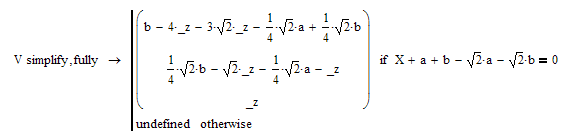
As Alan pointed out, the second system will not have a unique solution. If it has no solution at all or an infinite number of solutions depends on the rank of the extended matrix. If its 3, we will have no solution, if its 2 there is an infinite number of solutions. The latter case is for X=(sqrt(2)-1)*(a+b).

Mathcads result is inaccurate and misleading, but MC can do better using "fully":
fully.png

2 replies

19-Tanzanite
June 10, 2013

The determinant of the matrix multiplying the vector of (x, y, z) is zero.

An nxn nonhomogeneous system of linear equations has a unique non-trivial solution if and only if its determinant is non-zero. If the determinant is zero, then the system has either no nontrivial solutions or an infinite number of solutions.

Alan

lvl10720-TurquoiseAuthor
20-Turquoise
June 10, 2013

Thanks for your response. I agree with you, Alan. And I'm also observing those ( for example ) :

Solve%2C+X_.PNG

Best Regards.

25-Diamond I
June 10, 2013

Something like this?

fully1.png

Werner_E25-Diamond IAnswer
25-Diamond I
June 10, 2013

??Absolutely not sure what the question is. What should X be? Ther term for x from the first example??

As Alan pointed out, the second system will not have a unique solution. If it has no solution at all or an infinite number of solutions depends on the rank of the extended matrix. If its 3, we will have no solution, if its 2 there is an infinite number of solutions. The latter case is for X=(sqrt(2)-1)*(a+b).

Mathcads result is inaccurate and misleading, but MC can do better using "fully":

fully.png