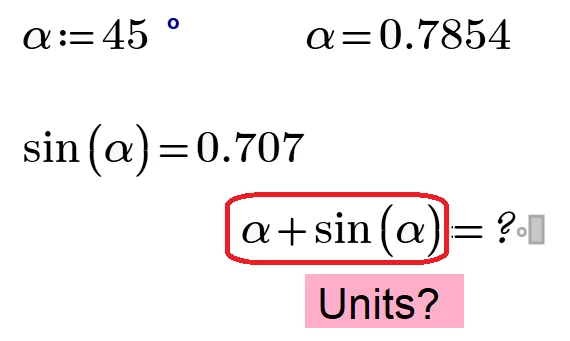
Only if one accepts that an angle *is* just the ratio of two lengths ... which hypothesis somewhat defies the observations of our eyes.
I prefer an alternative hypothesis in which the quantity angle is a base dimension within a system of units. This, to my eyes, makes more physical sense (how else does one capture the physical notion of rotation?). The maths works out, ... it's just that most people won't like the 'New Units Maths' because it changes how they would do dimensional analysis.
And yet, forgotten in years since Prime was a future prospect, is how some of us were looking forward to a 'clean sheet' Mathcad that would improve Mathcad by adding new features (eg, multi-dimensional arrays and full indexing support for nested arrays, extended control programmatic control over plot formatting, programmatic worksheet animation, greater programmatic access to objects, formatted strings (eg, get a string to evaluate to a (quote-symbol-less string, with full control over fonts, styles, etc (sort of a programmed Text Box), etc (I've got a list, a very long list ...)).
I think one thing that seems to have been lost is the desire to make Mathcad much better, not just live in hope that Prime will be as good as M15 one day. Ah well.
I do wish they'd left partial application in. It would have made working with Prime *so* much easier.