13-Aquamarine
December 16, 2025
Solved

Symbolic solver unit conversion with further substitution

  • December 16, 2025
  • 1 reply
  • 2692 views

Dear PTC Mathcad Community,

I want to ask for clarification on the behaviour of units and symbolic substitution in Mathcad Prime (similar topics have already been raised, but I still haven't found an appropriate answer for my issue).

 So I try to find a symbolic expression for epsilon_c2, which is a parameter of the equation N.

Solver succeeded with the issue, but with incompatible units (see picture)

Ivan_Pat_0-1765875279227.png

So, I have tried to find out the solution in the community, but the advice of @Werner_E  with calculation options didn't resolve the issue (see the picture)
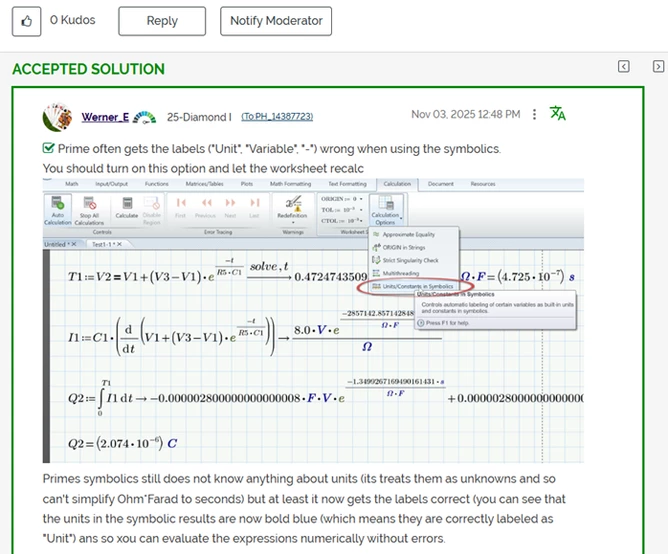
Ivan_Pat_1-1765875431392.png

So my issues are: 

1. How to make the symbolic solving more "seamless" with appropriate units' manipulation in the solutions?

2. Why does Mathcad not see the assigned values of the  epsilon_c2 obtained in the previous solution?
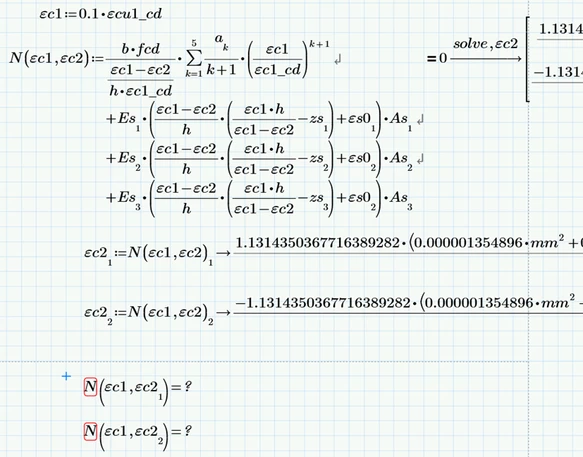
Ivan_Pat_2-1765875677338.png


After some time, when the file has been refreshed, some magic happened, and now I can use the roots of epsilon c1 and c2 in a "normal" manner.
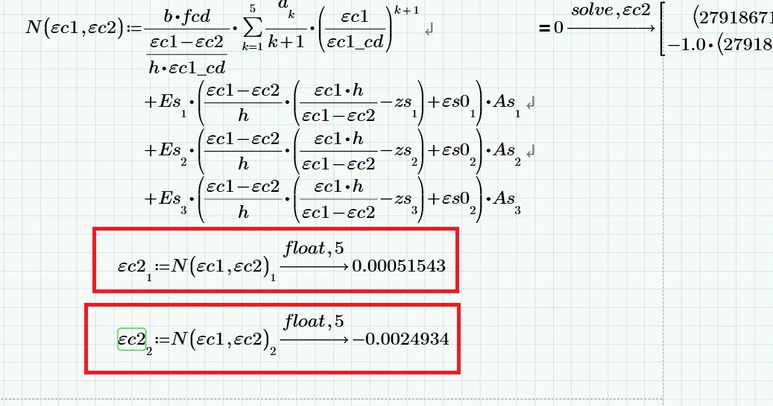
Ivan_Pat_1-1765882285970.png

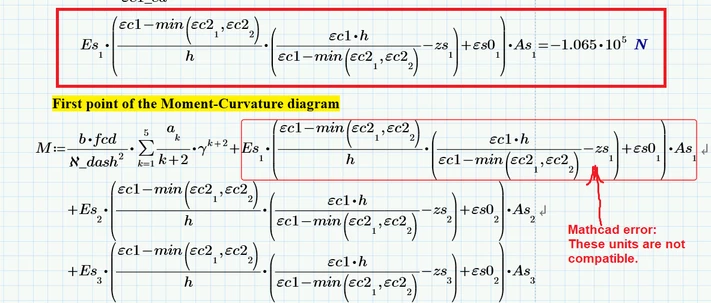
But the next issue is that it doesn't let me substitute the obtained symbolic solution into the following step calculation for the moment M calculation.
Ivan_Pat_0-1765882122108.png

As it can be seen, the factual equation is real, with proper units,

Nevertheless, Mathcad is still not satisfied with...


I am still convinced of Mathcad's power, but each time I get stuck with such a misunderstanding of Mathcad logic, I feel broken, exhausted and unable to continue to the next step - automation of my manual solution.


Any clarification, examples, or references to documentation would be greatly appreciated.
I am trying to align my workflow with my Mathcad Prime 10.0.0.0 internal logic rather than fight against it.

Thank you very much for your time and support.


The file with the manual calculation of M is attached.
 

Best answer by LucMeekes

The best way of using the symbolic solver is to use it with symbols only. That is:

- Do NOT use units.

- Do NOT use floating point numbers ( integers are OK, instead of 0.5 use 1/2, instead of 1.414... use √2 ).

It means that any variables you use in the symbolics are not assigned a (numeric) value.

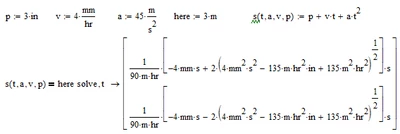
To obtain numerical results, you best assign the result of the symbolics to a function of all required variables and call that function with the numeric values, including their units.

So instead of:

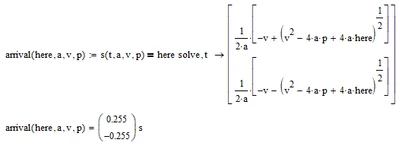
LucMeekes_0-1765890859949.png

do:

LucMeekes_1-1765890898351.png

Oh, and in case you are not interested in the symbolic solution, and you just want a numeric solution, then use a numeric solver (solve block, root() function or other suitable numeric function) instead of a symbolic one.


Success!
Luc

1 reply

LucMeekes23-Emerald IVAnswer
23-Emerald IV
December 16, 2025

The best way of using the symbolic solver is to use it with symbols only. That is:

- Do NOT use units.

- Do NOT use floating point numbers ( integers are OK, instead of 0.5 use 1/2, instead of 1.414... use √2 ).

It means that any variables you use in the symbolics are not assigned a (numeric) value.

To obtain numerical results, you best assign the result of the symbolics to a function of all required variables and call that function with the numeric values, including their units.

So instead of:

LucMeekes_0-1765890859949.png

do:

LucMeekes_1-1765890898351.png

Oh, and in case you are not interested in the symbolic solution, and you just want a numeric solution, then use a numeric solver (solve block, root() function or other suitable numeric function) instead of a symbolic one.


Success!
Luc

21-Topaz II
December 16, 2025

Hi Ivan,

You have set out to produce a reinforced concrete section moment-curvature diagram.

Want to help you but things vary from country to country.

Going back to your last post you have the polynomial coefficients for the shape of the concrete stress-strain block.

Can you show me a plot of the stress-strain block using these polynomial coefficients and values of relevant strain points as this is one of the things that vary between countries.


The problem can be solved without symbolics but using parametrized solve blocks, and root functions. 


Can you describe what the symbol gamma, and squiggly N are in equations 4.2.4?  Draw a diagram.


Look forward to hearing back.


Cheers

Terry


Ivan_Pat13-AquamarineAuthor
13-Aquamarine
December 16, 2025

@terryhendicott 

Hi Terry!

Glad to see the community members are interested in resolving my issue.


@terryhendicott wrote:

Hi Ivan,

You have set out to produce a reinforced concrete section moment-curvature diagram.

Want to help you but things vary from country to country.

Going back to your last post you have the polynomial coefficients for the shape of the concrete stress-strain block.

Can you show me a plot of the stress-strain block using these polynomial coefficients and values of relevant strain points as this is one of the things that vary between countries.


As you correctly mentioned, the moment-curvature "comprehensive" diagram could be represented by different equations:

1. Here, in our Code (Ukraine) two possible ways are possible (formula (3.4) or (3.5):

Ivan_Pat_0-1765892825879.png

Ivan_Pat_2-1765893052835.png


Where ak- polynomial coefficients (5), for each grade of concrete, is taken from Appendix D

Ivan_Pat_1-1765892928955.png

The difference between the curves, realised by our Code and the formula, which is used in Europe, may be in the USA, if I'm not mistaken, is not significant. To prove this, I compared the two curves in Excel.

Ivan_Pat_4-1765894015134.png


As you can see, both dependencies are pretty similar and close to each other.


...

The problem can be solved without symbolics but using parametrized solve blocks, and root functions.


I'd like to hear from you a simple example of how the ROOT function can be implemented here.

Thanks a lot for your interest in my topic.