
Solved

One compromise:
ELSID wrote:
Your not quite a diamond member ... YET
Yes you can do what you've done, BUT (i know, I just negated everything before the but), you can no longer use C or F as they are now "re-defined".
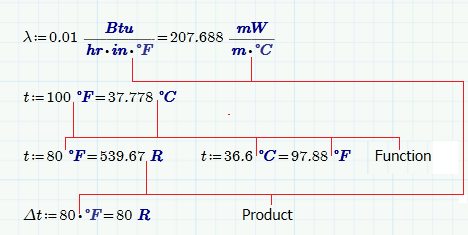
The definition in Mathcad of using DT works. As for your re-definition, the built-in DT values are DC=K and DF=(5/9)K and I can continue to use C or F without issues. I cannot emphasize enough that this works with papers, especially to clients and QA/QC staff who may not be as technically competent. They understand D (delta) is a change and the units after is universally accepted.
If this is a petition for PTC to eliminate the DT "unit as it currently stands, I vote to keep the status quo as my pee-wee non- PhD, diamond member, or hero of the month brain understands it clearly!
Maybe you're over thinking it Valery


I often find that educated engineers and good students usually a) know what it is default, which is widely used in engineering, c) know what is temperature and c) have ... sense of humor 
In the book from NIST and ASME (see the cover below) I see only °F but not deltaF in thermal conductivity unit and °R but not deltaF as entropy or (isobaric or isohoric) heat capacity units!

And second and last!
The main topic of this my messege http://communities.ptc.com/docs/DOC-3251
was not "conservative American and British people" but two temperature scale - ITS-68 and ITS-90.
PS
An old joke.
Father and son walking through Paris.
- Dad, who built the tower?
- Engineer Eiffel.
- It's like my mother - an engineer?
- No, my son, your mother is a lead engineer!

Welcome to the PTC Community
No account yet? Create an account
Please use your PTC eSupport account.
LoginEnter your E-mail address. We'll send you an e-mail with instructions to reset your password.