
12-Amethyst
April 2, 2013
Solved

The solution of the integral below should have an imaginery part but only shows the real part

  • April 2, 2013
  • 11 replies
  • 3885 views

I need to calculate the semi-infinite integral that appears in the attached pdf file and the solution should have imaginary part. But, for some reason that I do not know, it is just given me the real part.

j inside the integral is the imaginery term.

Thank you in advance,

Rogelio

Best answer by Werner_E

Second approach using a different program (Derive 6)
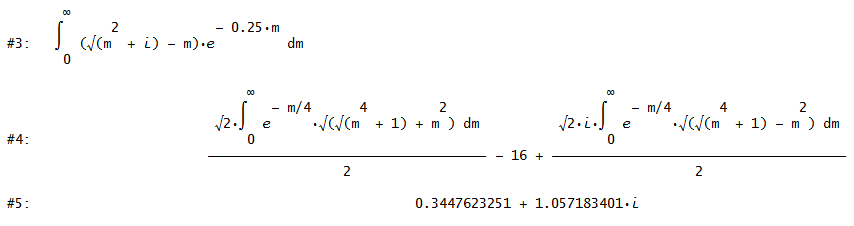
int3.png

Using this information, Mathcad is able to yield the correct result:
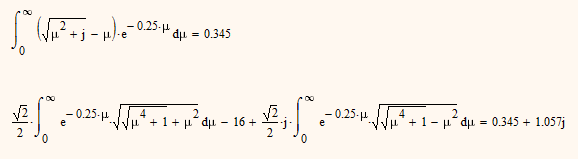
int2.png

Again with the help of Derive we can rewrite your function J so that even Mathcad yields the correct results:
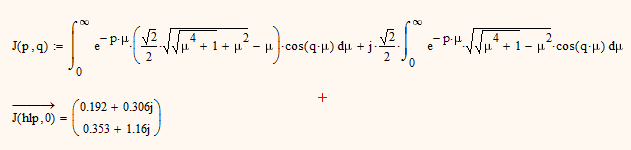
int4.png

11 replies

1-Visitor
April 2, 2013

Attaching your worksheet using the advanced editor (see the upper right-hand area of the normal editor) will help people see what you are doing. I strongly suggest you do this.

Werner_E
25-Diamond I
April 2, 2013

You are right, one would expect an imaginary part.

Numerical deficiency or bug? Guess the first.

Did you try symbolic eval? I had to stop - it took too long.

int1.png

Werner_E
Werner_E25-Diamond IAnswer
25-Diamond I
April 2, 2013

Second approach using a different program (Derive 6)

int3.png

Using this information, Mathcad is able to yield the correct result:

int2.png

Again with the help of Derive we can rewrite your function J so that even Mathcad yields the correct results:

int4.png

12-Amethyst
April 3, 2013

Mr. Werner,

I really like what you have done here.

But I do not "see" how you arrive to this form for the square root complex component.

Can you give me a reference where i can read about this?

I have several problems to solve that will all include this kind of solutions. If I can learn how to arrive to these complex component, in the way that you did, that will be terrific!!

Thank you very much for all your help.

Regards,

Rogelio

Werner_E
25-Diamond I
April 3, 2013

Rogelio de las Casas wrote:

Mr. Werner,

I really like what you have done here.

But I do not "see" how you arrive to this form for the square root complex component.

Can you give me a reference where i can read about this?

I have several problems to solve that will all include this kind of solutions. If I can learn how to arrive to these complex component, in the way that you did, that will be terrific!!

Thank you very much for all your help.

Regards,

Rogelio

Sorry, as already written I have not done the transformation myself by hand but had used another math program to do the job and simply retyped it. Later I tried if Mathcads symbolics would do the trick (using the modifier rectangle) but I had no succes - maybe I tried not hard enough, as Mathcads symbilics can be quite tricky.

See attached.

I have just gave it a try and found a way to do the transformation manually with the term, that can throw complex results, using Mathcad only to solve a system of equations. Don't worry about the red errors, they apply only to numerics, we use symbolics here. It would be more correct to write L(my):=...

and a(my):=L(my)[0,0 etc.

int5.png

12-Amethyst
April 3, 2013

Werner,

I tried the solution of mathcad for the square function from your previous message and it did not work.

I have attached the file that you sent me first with some comments.

The good thing is that your first solution from Derive, did work very well and I could reproduce the examples from the paper that I was studying.

Thanks again

Rogelio

Werner_E
25-Diamond I
April 3, 2013

I am not sure if we see the same, if its a version conflict (I am using Mathcad 15 M020) or maybe only a misunderstanding.

I include a worksheet with a manual proof that the expressions by derive and MC are equivalent.

Also a pdf of the file so you see how it looks for me