

24-Ruby IV
September 24, 2016
Question

Travel from home to school with... Fermat (сайт статьи "Путешествие от дома в школу по маршруту Ферма")

  • September 24, 2016
  • 2 replies
  • 20462 views

Figures and Mathcad- and Maple-sheets of the article

Рисунки и Mathcad & Maple документы статьи
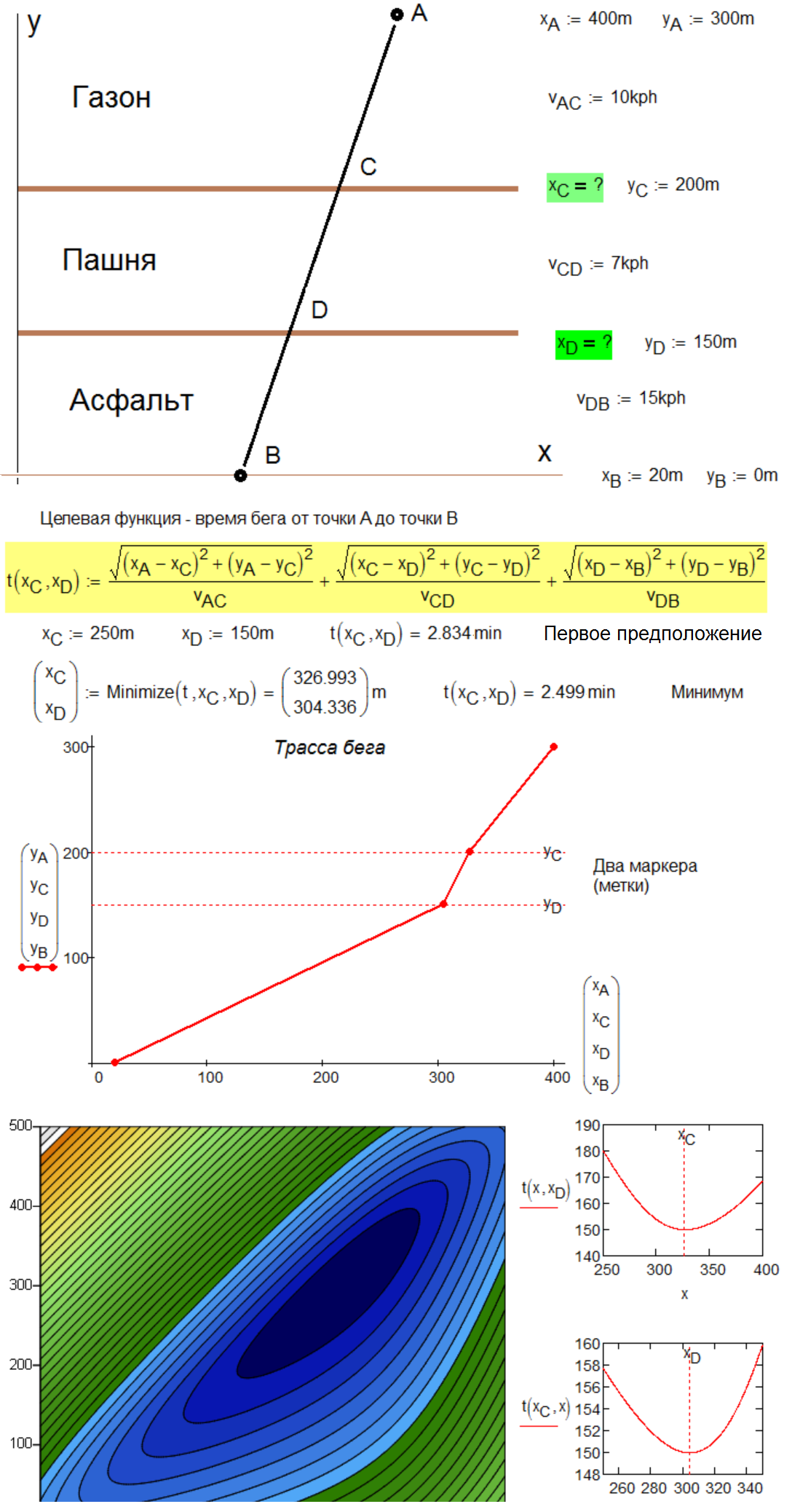
1-Run-Min.png


Рис. 1. Задача о беге по газону, пашне и асфальту: оптимизация

Fig. 1. The problem of running across the lawn, plowing and asphalt optimization

Проблемы, возникшие при решении этой задачи (Problems with this problem):

Why I cannot create a counter plot

One minimize problem - numerical and symbolical solutions


2 replies

24-Ruby IV
September 24, 2016

Рис. 2. Задача о беге по газону, пашне и асфальту: решение системы двух «оптических» уравнений

Fig. 2. The problem of running across the lawn, plowing and asphalt: the solution of the two "optical" equations

24-Ruby IV
September 24, 2016

3-Mirag.png

Рис. 3. Физическое объяснение миража

ig. 3. The physical explanation of mirage

24-Ruby IV
September 24, 2016

3-Zoom.png

Рис. 4. Решение дифференциального уравнения линзы

Fig. 4. Solution of the lens of the differential equation

24-Ruby IV
October 31, 2016

The new (11/11/2016) variant article in attach!

1-Visitor
November 13, 2016

Конические сечения (эллипс, парабола, гипербола) вообще обладают простыми, и, в то же время, удивительными свойствами. Лучи выходящие из фокуса "двухфокусных" сечений (эллипса и гиперболы) обязательно имеют продолжение во втором фокусе, независимо от того падают они внутри или снаружи эллипса и гиперболы. А лучи выходящие из фокуса параболы после отражения превращаются в параллельные лучи (также независимо от того внутри или снаружи параболы они падают). Глубоко уважаемый Crusoe Журнал Crusoe с применением этих свойств конических сечений провел увлекательное исследование на тему известнейшего произведения А.Н. Толстого "Гиперболоид инженера Гарина" в своем Третье зеркало.: crusoe и пришел к нетривиальному выводу!

24-Ruby IV
November 14, 2016

Better in English

Conic sections (ellipse, parabola, hyperbola) generally have a simple and, at the same time, surprising properties. Beams exiting out of focus "bifocal" in cross section (ellipse and hyperbola) necessarily have continued in the second focus, whether they fall inside or outside the ellipse and hyperbola. After reflection the rays emerging from the focus of the parabola are converted into parallel beams (regardless of whether inside or outside the parabola they fall). Deeply respected Crusoe Crusoe Journal using these properties of conic sections had a fascinating study on the subject of the famous works of AN Tolstoy "hyperboloid of Engineer Garin" in its third mirror .: crusoe and came to the conclusion that a non-trivial!