1-Visitor
September 6, 2014
Solved

two signals max/min coincide

  • September 6, 2014
  • 8 replies
  • 4079 views

Hello All,

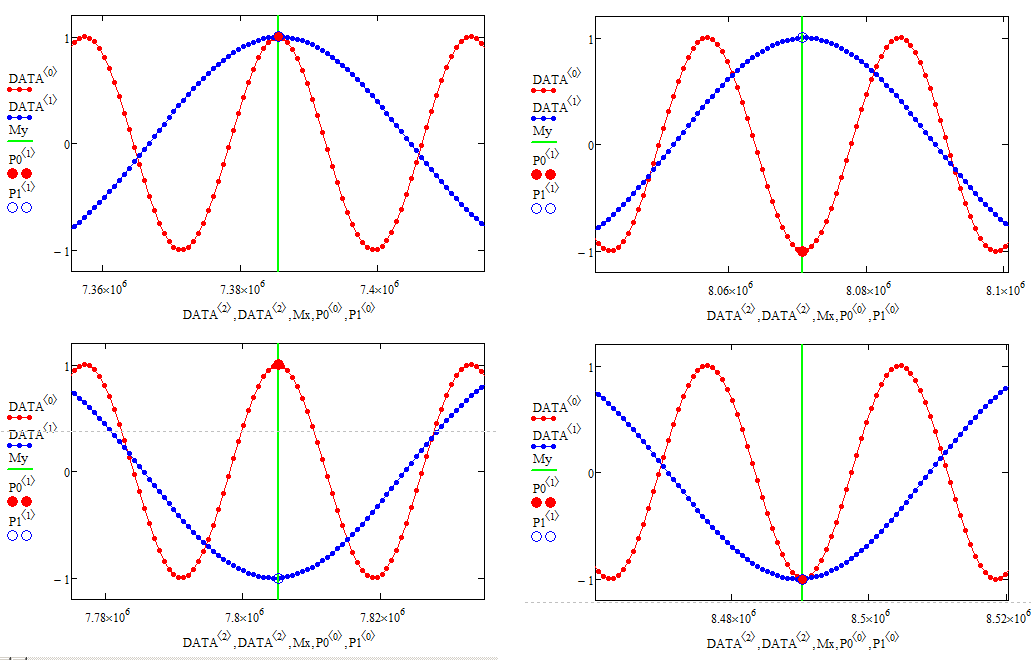
I have two oscillating signals. I want to find the position where

1) The signals maxima coincide with each other (the best match),

2) The signals minima coincide with each other (the best match),

3) One signal's max coincides with another signal's min.

Such points are indicated on the attached graph. Would you please help me with programming this step?

Thank you very much in advance.

Payman

Best answer by Werner_E

PAYMAN RAJAI wrote:

Hello Werner,

Thank you for the hint.

I guess they are more clear in the attached picture. (the indication numbers were in black color, not easy to see)

I had not looked at the attached picture, just the worksheet.

About the sum of two signals, is it correct to say:

The max of the sum corresponds to the coincidence of the signals maxima

The min of the sum corresponds to the coincidence of the signals minima

Yes, but only if we assume the the maxima or minima will coincide at one position.

How about the coincidence of one max and one min? in that case the sum would be close to zero but it may also happen when two signals zeros coincide with each other.

In this case the sum is useless anyway. Think of two signals with different amplitude - the sum would not be zero at all!

But here min and max of the difference signal do the job.

But you have to be aware that this is a discrete approach which works with the data points only. No interpolation or fitting is done. If there is no data point at the max or min, we miss it.

So Freds approach of finding amplitude, frequency and phase for both signals first might be more appropriate.

See attachment.
1.png

8 replies

Werner_E
25-Diamond I
September 6, 2014

Such points are indicated on the attached graph.step?

?? I only see a marker at k0 and this position does not correspond to either of your description. See screenshot of magnified position below.

How about looking at the max and min values of the sum of the two signals to get the positions you are looking for?

1.png

payman1-VisitorAuthor
1-Visitor
September 6, 2014

Hello Werner,

Thank you for the hint.

I guess they are more clear in the attached picture. (the indication numbers were in black color, not easy to see)

About the sum of two signals, is it correct to say:

The max of the sum corresponds to the coincidence of the signals maxima

The min of the sum corresponds to the coincidence of the signals minima

How about the coincidence of one max and one min? in that case the sum would be close to zero but it may also happen when two signals zeros coincide with each other.

Werner_E
Werner_E25-Diamond IAnswer
25-Diamond I
September 6, 2014

PAYMAN RAJAI wrote:

Hello Werner,

Thank you for the hint.

I guess they are more clear in the attached picture. (the indication numbers were in black color, not easy to see)

I had not looked at the attached picture, just the worksheet.

About the sum of two signals, is it correct to say:

The max of the sum corresponds to the coincidence of the signals maxima

The min of the sum corresponds to the coincidence of the signals minima

Yes, but only if we assume the the maxima or minima will coincide at one position.

How about the coincidence of one max and one min? in that case the sum would be close to zero but it may also happen when two signals zeros coincide with each other.

In this case the sum is useless anyway. Think of two signals with different amplitude - the sum would not be zero at all!

But here min and max of the difference signal do the job.

But you have to be aware that this is a discrete approach which works with the data points only. No interpolation or fitting is done. If there is no data point at the max or min, we miss it.

So Freds approach of finding amplitude, frequency and phase for both signals first might be more appropriate.

See attachment.

1.png

23-Emerald I
September 6, 2014

You won't get a clean answer, but Fourier analysis can get you started:

payman1-VisitorAuthor
1-Visitor
September 7, 2014

Thank you very much Fred,

I have a few questions to understand your approach thoroughly.

1- why S1 and S2 are multiplied by factor "2" to obtain the amplitudes?

2- How do you find the proper phase values from the argument of S1 and S2?

3- How can I extract my desired positions at the end of the program?

Sorry if my questions are unintelligent.

Thank you

Payman

23-Emerald I
September 8, 2014

PAYMAN RAJAI wrote:

1- why S1 and S2 are multiplied by factor "2" to obtain the amplitudes?

That's jus the way thwe CFFT function works, read help topics.

2- How do you find the proper phase values from the argument of S1 and S2?

I didn't, as the phase graph shows. The values of phase were developed by inspection.

3- How can I extract my desired positions at the end of the program?

Good question. A derivative would give you the inflection points. How you sorted out maxima and minima would require thought.

Sorry if my questions are unintelligent.

Thank you

Payman