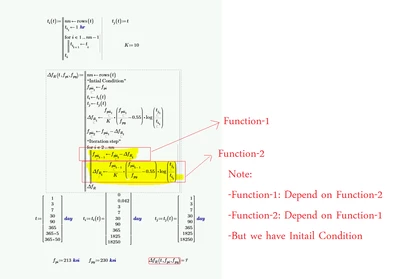
Best answer by Fred_Kohlhepp

It's not clear to me what you're trying to do.  Your time steps seem grossly spaced.  I don't have "real" Mathcad, only Prime Express, so I cannot program.  


I tried to implement what you did, printed the results as pdf.  (If you type the math expressions in "real" Mathcad they should work.)  You can't take a logarithm of zero, so the first element in each time vector was made very small.


See if this helps.

2 replies

23-Emerald I
September 24, 2020

It's not clear to me what you're trying to do.  Your time steps seem grossly spaced.  I don't have "real" Mathcad, only Prime Express, so I cannot program.  


I tried to implement what you did, printed the results as pdf.  (If you type the math expressions in "real" Mathcad they should work.)  You can't take a logarithm of zero, so the first element in each time vector was made very small.


See if this helps.

15-Moonstone
September 26, 2020

Thank  

SPRstructur_0-1601088324565.png

However I tried to do manual calculation It maybe corrected answer for comparing


Thank you

SPRstructur_0-1601089149494.png


25-Diamond I
September 26, 2020

This is what Fred suggested

Werner_E_0-1601109496066.png

You typed something different (especially you typed just index "i" instead of "i-1"twice.

Here is the sheet and screenshot with the results when you correct this:

Werner_E_1-1601109923729.png


23-Emerald IV
September 24, 2020

As Fred indicated: It's not clear what you are trying to accomplish.

And I'm also limited wrt Prime: only Prime Express, so no programming.

Some observations:

1. By default arrays are indexed starting at 0, not at 1. That is why there is a leading 0 in the ti array (middle, bottom of the page). So all your ti(t) program does is replace the first value of t (1 day) with a value of 1 hour, and precede that element with a new element with a value of 0.

There is a global variable ORIGIN that sets the index of the first element. You can set it to either 0 or 1, but you can also use it in your program. Instead of  "for i e 1..nn-1" you could write "for i e ORIGIN..nn-1" if you meant to start at the beginning of the array.

2. Do you have more sophisticated plans with the function tj(t)? Otherwise it's better to just write tj:=t.

3. In the calculation of the initial value for DeltafR, you are taking the logarithm of the ratio of tj1 and ti1. Now tj1=3 days and ti1 is 0.042 days. Was this intended?

4. Now the error message says that you are indexing an array out of bounds. That is due to two reasons:

a.In the for loop you are assigning a new value to fppi[i-1. In the first pass, i-1=1 so you are assigning a value to fppi[1, to be equal to fppi[1-DeltafR[2. Now DeltafR[2 doesn't exist yet. I bet you meant to do:

fppi[i <- fppi[i-1  - DeltafR[i-1

b. the fact that you are indexing the ti array up to its length, because nn=rows(t). When indexing starts at 0, you can only index to rows()-1. There is a standard function for the last index of an array: last().


See if the attached helps. Especially if it delivers the right answer, when it delivers one... (I can't run it, but I can edit the program)


Success!
Luc

15-Moonstone
September 26, 2020

LucMeekes

it still error with my mathcad

SPRstructur_0-1601088980927.png


23-Emerald IV
September 26, 2020

Thanks Werner.

With Express I can edit an existing program, to a certain extent, but cannot run it.


Luc