

1-Visitor
December 28, 2011
Solved

difference between circularity and circular runout

  • December 28, 2011
  • 3 replies
  • 41473 views

what is the difference between circularity and circular runout? and cylindrecity and total runout in tolerance?

do they use only axis as refence or any other reference?

shankar


This thread is inactive and closed by the PTC Community Management Team. If you would like to provide a reply and re-open this thread, please notify the moderator and reference the thread. You may also use "Start a topic" button to ask a new question. Please be sure to include what version of the PTC product you are using so another community member knowledgeable about your version may be able to assist.
Best answer by KshetrabasiMaha

Hi

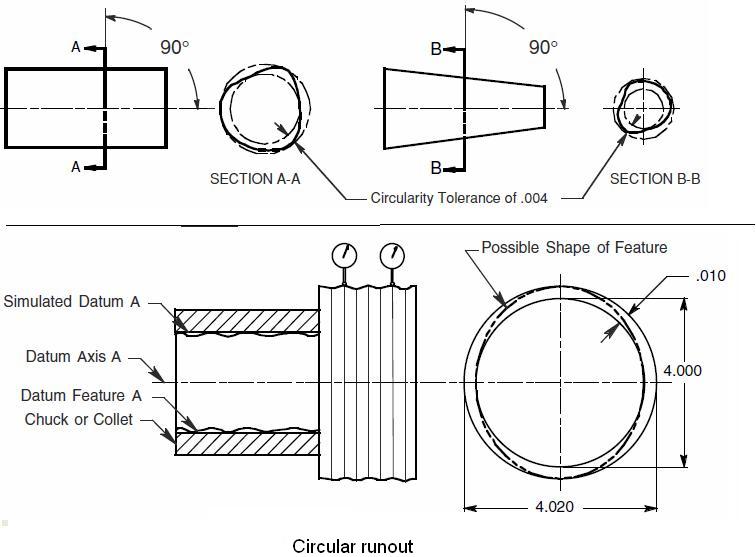
When you check circularity you are checking the variation in the circle with out considering any datum

But when you are checking the variation with reference to a datum then it is Circular runout

(Circular runout is the combination of Circularity and Coaxiality)

In simpler words when we fix the job axis and check the variation with dial gauge you check-Circular runout

But when you do not consider any datum then it is circularity

Let suppose a part at a section is having less deviation in circularity may have higher circular runout value if it is axially shifted from the datum

Regards

K.Mahanta

circularity.JPG

Message was edited by: kshetrabasi mahanta (image added)

3 replies

1-Visitor
December 29, 2011

I would define it thus....

  1. Take a cylinder / cone
  2. Divide the cylinder / cone into number of sections

Circularity

At each section you would get a circle. Circularity is the VARIANCE of this circle from the THEORETICAL circle. Generally, 4 points are taken for measurement. These 4 points would give you 4C3 circles or 4 circles. An average of these FOUR circles is taken to define the deviation.

Cylindricity

  1. While circularity is applicable for both Cone and Cylinder, Cylindricity is the VARIANCE of EACH of these circles obtained accross the length of the cylinder.

Runout

  1. Runout is the measure of the deviation with respect to the AXIS. While runout is to ONE side, Total Runout or TIR is the TOTAL Runout as the part rotates by 360 deg or the total VARIATION seen on the Dial Gauge.
1-Visitor
December 29, 2011

Thanks.

understood to some extent. can anybody explain in more easier way to understand. i am a beginner, so i need little more explanation.

shankar

1-Visitor
December 29, 2011

Do a search for geometric tolerancing then go and do a course on it.

http://www.tec-ease.com

Its fundametal to mechanical engineering and is usually not taught at engineering schools. Some would say its a black art.

1-Visitor
December 30, 2011

Hi

When you check circularity you are checking the variation in the circle with out considering any datum

But when you are checking the variation with reference to a datum then it is Circular runout

(Circular runout is the combination of Circularity and Coaxiality)

In simpler words when we fix the job axis and check the variation with dial gauge you check-Circular runout

But when you do not consider any datum then it is circularity

Let suppose a part at a section is having less deviation in circularity may have higher circular runout value if it is axially shifted from the datum

Regards

K.Mahanta

circularity.JPG

Message was edited by: kshetrabasi mahanta (image added)

18-Opal
October 22, 2015

Hi Shankar,

If one of the responses helped resolve your issue, would you please mark it as the Correct Answer?  That way other users visiting the discussion will know; as the correct answer gets copied right below the question.

Thanks,

Amit

Dale_Rosema
23-Emerald III
23-Emerald III
October 22, 2015

Why are you reviving an almost 4 year old thread? Just curious.

18-Opal
October 22, 2015

Just doing some clean up to close out older discussions.