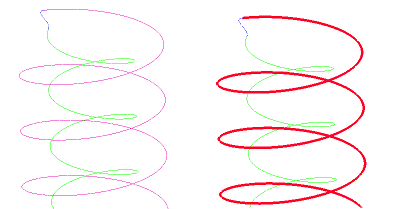

Winch Cable wound on drum
Using WF4, here.
I have been asked to create a model of a cable, wound in a series of layers onto a spool, like a winch cable onto a drum.
The smart money says 'Don't do it', because it will take an age to regenerate. I know that. However, I want to know how to do it anyway. I'm curious like that.
I first made a series of curves based on equations like the one shown below:
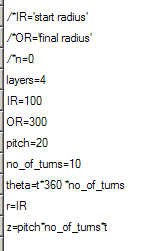
For each layer, I reversed the z direction, incremented the r value and started theta with an offset so I could fake the join between layers using a curve between points, tangent at each end to the spiral curves.
Once I had a series of coiled layers and joins between them, I tried to Copy, Paste, Approximate, the curves to make the whole ugly mess into a single composite curve. No! Can't do that. No idea why not, but Pro/E insists they should all remain separate curves.
So, then I made a series of separate VSS features, one for each layer and one for each joining piece.
That worked after a fashion, I ended up with the model shown:
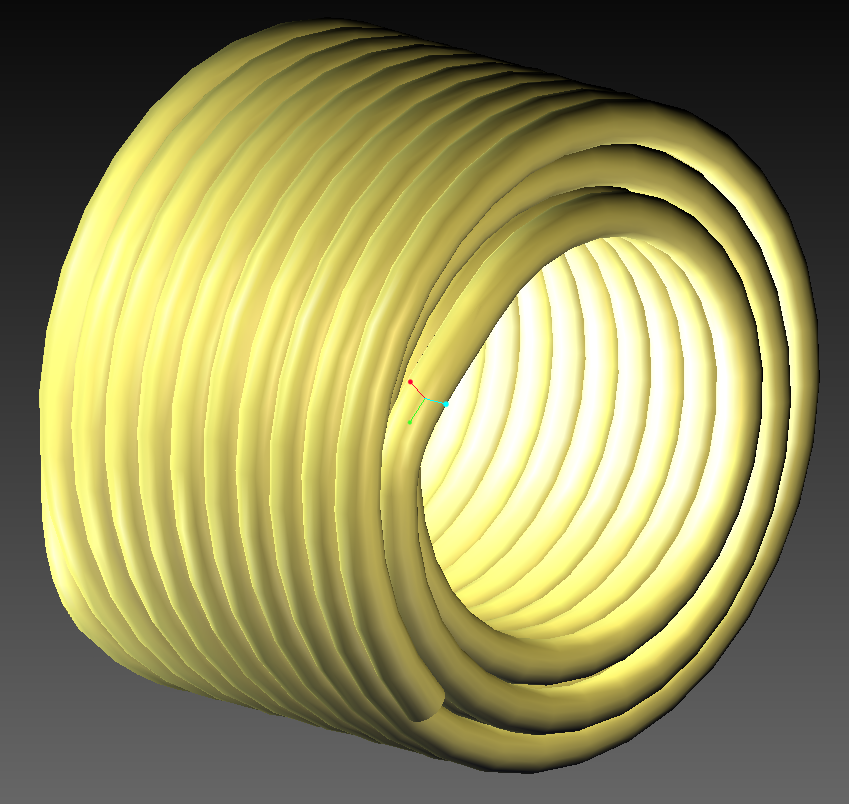
However, what I would ultimately like to do is to have the whole cable as a singe curve and control the number of layers by making the overall curve length a fixed value. So, if I tell it that 10m of cable is paid out from the winch, I want to have the remainder shown coiled up on the drum.
I therefore tried to write an equation for all the layers. Now, I'm no programmer and I'm doing this in the Pro/Table editor that starts up when you insert a datum curve from equation, so I am working with a bit of a handicap to start with. Clearly, I want to increment my radius by the pitch value and reverse my z direction each time my theta reaches no_of_turns*360. Problem is, Pro/Help tells me I can't use the ABS, FLOOR or CEIL functions in a curve equation.
Is it, therefore, even possible to do what I am trying to do with a single equation?
If not, is it possible to combine all my separate curves into a single composite curve, despite what Pro/E tells me?
I look forward to your comments on this interesting little conundrum.
Cheers,
John