1-Visitor
October 25, 2014
Solved

why strange solutions obtained?

  • October 25, 2014
  • 3 replies
  • 2269 views

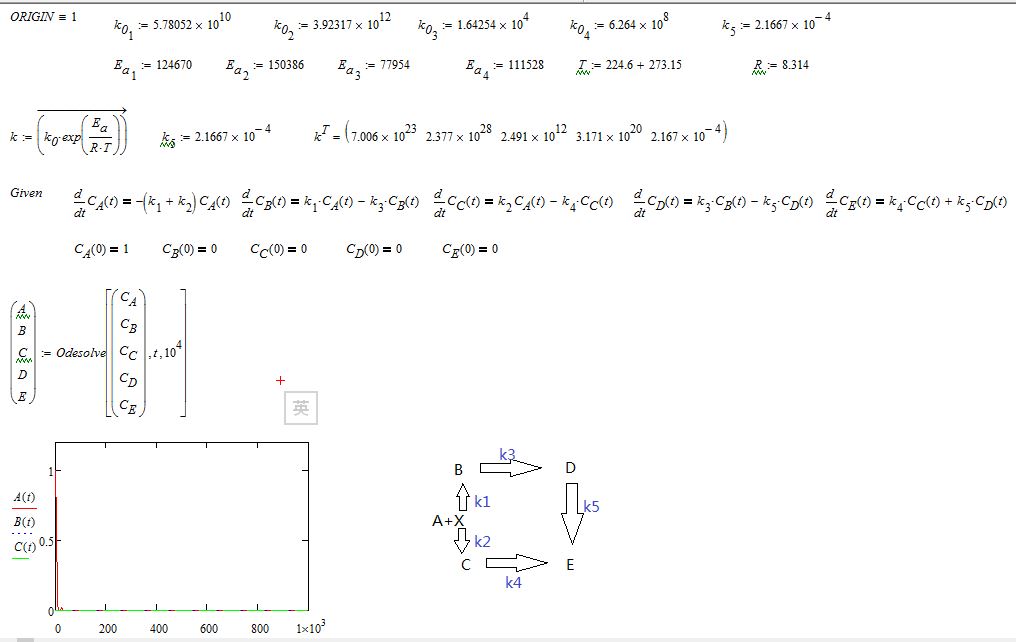
a simple example, but got strange results. while matlab can give reasonable answers, but i dont like the matlab codes. see in attached

kinetics+odes.JPG

Best answer by Werner_E

Maybe it would help if you explain why you think that the result is wrong and what result (Matlab screenshot) you expect.

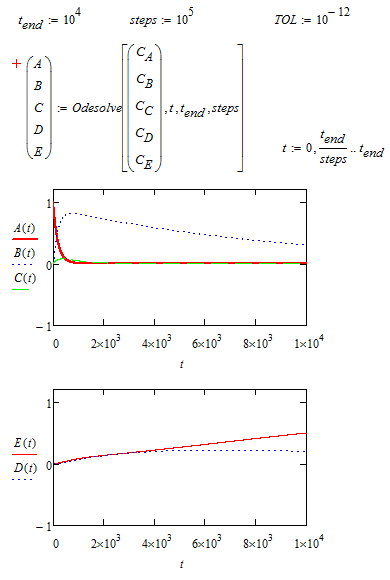
You want the system to be solved for a time interval up to 10^4 but you allow just (the default) 10^3 steps. A step width of 10 time units maybe is too large for a meaningful result. You may consider to solve for a smaller time interval and/or increase the number of iteration steps (thats an additional argument of odesolve).

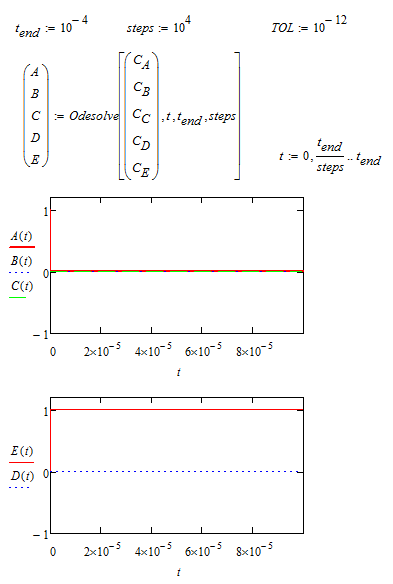
I tried and the result is that A(t) goes down to zero right at the beginning when the precison is enhanced that way.

It looks like A is transferred amost immediatly to E, which is, looking at your coefficients k, no big surprise. Could it be a problem with numerical precision or what result did you expect? Your coefficients are rather big and k3 and k5 seem to be nearly neglectable compared to the others. Are you sure you used the same equations and the same coefficients in Matlab?
1.png

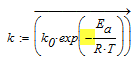
Can it be that it should be

2.png

3.png

3 replies

Werner_E
Werner_E25-Diamond IAnswer
25-Diamond I
October 25, 2014

Maybe it would help if you explain why you think that the result is wrong and what result (Matlab screenshot) you expect.

You want the system to be solved for a time interval up to 10^4 but you allow just (the default) 10^3 steps. A step width of 10 time units maybe is too large for a meaningful result. You may consider to solve for a smaller time interval and/or increase the number of iteration steps (thats an additional argument of odesolve).

I tried and the result is that A(t) goes down to zero right at the beginning when the precison is enhanced that way.

It looks like A is transferred amost immediatly to E, which is, looking at your coefficients k, no big surprise. Could it be a problem with numerical precision or what result did you expect? Your coefficients are rather big and k3 and k5 seem to be nearly neglectable compared to the others. Are you sure you used the same equations and the same coefficients in Matlab?

1.png

Can it be that it should be

2.png

3.png

FanCG1-VisitorAuthor
1-Visitor
October 26, 2014

Thank u very much for the explainations!

The keyponit lies in the negative symbol before activie energy.

24-Ruby IV
October 26, 2014

Fan CG wrote:

Thank u very much for the explainations!

The keyponit lies in the negative symbol before activie energy.

Yes, Werner is one "minus guru"

See please http://communities.ptc.com/message/260444