
12-Amethyst
January 7, 2018
Solved

Automatic solution of multilayer stady heat transfer as a function of layers number

  • January 7, 2018
  • 8 replies
  • 10934 views

Hi,


I'm looking a way of automatic solution of HT problem with multilayer steady heat transfer with numbers of layer dependency.

I'd like to put n variable as number of materials layer then put thicknes and thermal conductivity as a consequences of layer namber and finally get a solution for n=2,3...k layers. 
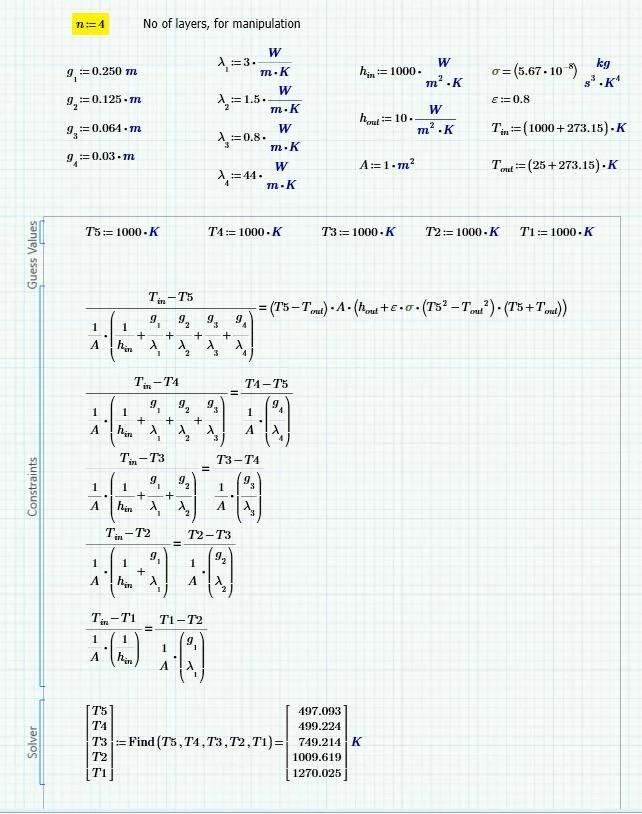
 

HT automatic solution as a number of layers.jpg

Thank you in advance for any idea


I enclose MP 4.0 file.

wzel
Best answer by DJF

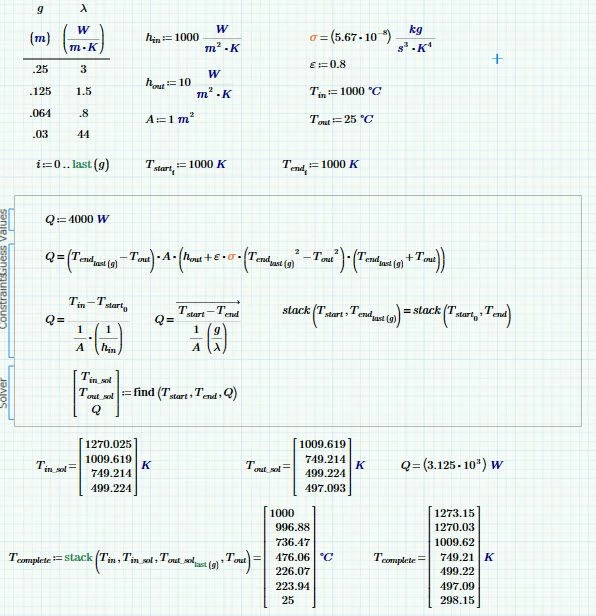
I think the link did that, although yours is complicated by having different equations at the start and end.  But the concept is the same.  Since I can probably use something similar someday, I took a stab at it.  Seems to work - you can add or delete rows to the table. But user beware, etc.

T_start is the temp at the start of a 'plate', and T_end is the temp at the end of a plate.  

HT.jpg

8 replies

24-Ruby IV
January 7, 2018

May by this Mathcad-Websheet is any help for you

http://twt.mpei.ac.ru/MCS/Worksheets/Thermal/T-T-2-Chapter-3-3-3-1.xmcd


wzelik12-AmethystAuthor
12-Amethyst
January 7, 2018

Thank you both, Valery and DJF.


The problem is that I have to solve the non-linear equation due convecting and radiation therms which are set as outflow boundary condition.
This is a first step to get interlayer and inflow temperatures.

wzel

DJF16-PearlAnswer
16-Pearl
January 7, 2018

I think the link did that, although yours is complicated by having different equations at the start and end.  But the concept is the same.  Since I can probably use something similar someday, I took a stab at it.  Seems to work - you can add or delete rows to the table. But user beware, etc.

T_start is the temp at the start of a 'plate', and T_end is the temp at the end of a plate.  

HT.jpg

16-Pearl
January 7, 2018

I think this is similar to a problem I posted here (N orifices in series).


https://community.ptc.com/t5/PTC-Mathcad-Questions/Solve-block-for-N-inputs/m-p/484610#M173308


See MJG's solution - the trick is in the 'stack'ing of the pressures.